

Decoding Personal Injury Lawyer Fees in Texas
Confused about personal injury lawyer fees? This guide breaks down contingency fees, case costs, and how your final settlement is calculated in Texas.
If you've been injured in an accident in Texas, one of your first questions is probably, "How can I possibly afford a lawyer?" It’s a completely valid concern, especially when you're facing medical bills and lost wages.
The good news is, in Texas, personal injury lawyer fees almost always work on a contingency fee basis. In simple terms, this means you pay no upfront costs for legal representation. Your attorney's fee is a percentage of the money they recover for you, whether that's through a settlement or a court award.
If your lawyer doesn't win your case, you owe them nothing for their time and effort. It’s that straightforward.
Decoding the Contingency Fee Model

When you're trying to heal, the last thing you need is another bill. The contingency fee system was designed specifically to remove that financial barrier, giving everyone access to quality legal help, no matter their bank account balance.
Think of it as a partnership. Your lawyer is essentially investing their firm's resources—their time, knowledge, and money—into your case. Their payment is entirely contingent on getting a successful result for you. This setup creates a powerful alignment of interests; the only way your attorney gets paid is by getting you paid.
The core principle is simple: "No Win, No Fee." This phrase perfectly captures the essence of the contingency model. You won't owe your attorney a dime for their legal services unless they successfully recover money for you.
How Fee Percentages Change With Case Progression
The exact percentage isn't one-size-fits-all. It usually changes based on how much work your case requires and how far it has to go in the legal system. A case that settles quickly requires less of the firm's resources than one that goes all the way to a jury trial.
Most Texas personal injury lawyers work on a sliding scale, with fees typically ranging from 25% to 40% of the total recovery. For example, a case that settles early, before a lawsuit is even filed, might have a fee on the lower end. If your lawyer has to file a lawsuit and engage in a lengthy legal battle, the percentage will naturally be higher to reflect that massive increase in work. You can always explore a more detailed breakdown of lawyer cost structures to see how this applies in different scenarios.
To give you a clearer picture, here’s a quick summary of how these percentages often work in Texas.
Typical Contingency Fee Percentages in Texas
This table illustrates how a lawyer's fee percentage typically changes based on the stage at which your personal injury case is resolved.
| Case Stage | Common Fee Percentage Range | Description |
|---|---|---|
| Pre-Lawsuit Settlement | 25% - 33.3% | The case is resolved through negotiations with the insurance company before a formal lawsuit is filed in court. |
| Post-Lawsuit Settlement | 33.3% - 35% | A lawsuit has been filed, but the case settles before going to a full trial, often during mediation or discovery. |
| Resolution After Trial | 35% - 40% | The case proceeds through a complete trial, and the resolution comes from a jury verdict or judge's decision. |
As you can see, the fee reflects the risk and resources committed by the law firm. This tiered structure is standard practice and should be clearly outlined in any fee agreement you sign.
A Practical Look at Your Contingency Fee Agreement
Think of the contingency fee agreement as the financial engine for your personal injury case. It’s the document that puts the "no win, no fee" promise in writing, legally tying your lawyer’s paycheck directly to your success. This is the standard in injury law for one simple reason: it gives you access to justice without having to pay a lawyer upfront.
This model makes you and your attorney partners with a shared goal. They're betting their firm's time, money, and expertise on your case. They only get paid if they secure a recovery for you, which creates a powerful incentive to fight for the best possible result.
What Percentage Do Lawyers Take in Texas?
In Texas, you can generally expect a personal injury lawyer’s contingency fee to be between 33.3% and 40% of the total settlement or verdict. The most common rate you’ll see, especially for cases that settle before a lawsuit is filed, is one-third (33.3%).
But that number isn't set in stone. The final percentage in your agreement will often depend on a few key things:
- Case Complexity: A simple rear-end collision where the other driver is clearly at fault will likely land at that standard 33.3%. A complex medical malpractice case or a multi-vehicle pileup with finger-pointing from all sides? That requires a ton more work and often justifies a higher fee.
- Case Progression: If your lawyer can negotiate a fair settlement with the insurance company relatively quickly, the fee usually stays on the lower end. But if they have to file a lawsuit, go through months of gathering evidence (discovery), and gear up for a trial, that percentage will often climb to 35% or even 40% to account for the massive increase in time and resources.
- Firm Experience: A law firm known for taking on tough cases and winning big verdicts might charge a bit more. You’re paying for their proven track record and specialized expertise.
The most important thing is that this fee structure is spelled out in black and white in your agreement. There should be zero confusion about what percentage applies and when.
How Contingency Fees Are Calculated
Let’s put some real numbers to this to see how it works. It's much simpler than it sounds.
Imagine you were hurt in a car wreck, and your lawyer negotiates a $90,000 settlement with the insurance company. Your fee agreement states the fee is 33.3% (one-third) of the recovery.
Here’s the breakdown:
- Start with the Gross Settlement Amount
- Total Settlement: $90,000
- Apply the Contingency Fee Percentage
- Attorney's Fee: $90,000 x 0.333 = $29,970
Just like that, the attorney’s fee for their work is $29,970. This amount comes directly out of the $90,000 settlement funds.
Important Distinction: This math only covers the lawyer's fee. It doesn't include case costs and expenses, which are separate items deducted from your settlement. We’ll get into those next.
Getting a handle on this basic calculation is the key to understanding the financial side of your claim. It takes an abstract percentage and turns it into a real dollar amount, showing you exactly how your attorney gets paid. Before you sign anything, you should feel confident you can do this math yourself so everyone is on the same page from day one.
Attorney Fees vs. Case Costs: What You Actually Pay
When a settlement check finally arrives, seeing that big number can be a huge relief. But it's important to remember that the total amount isn't what will land in your bank account. To really understand your final payout, you have to get clear on two very different deductions: attorney fees and case costs.
Mixing these two up is a common mistake that can lead to some serious sticker shock when you see the final breakdown.
Think of it this way: the attorney's fee is what you pay your lawyer for their time, expertise, and the legal heavy lifting they did for you. This is the contingency fee percentage—their payment for getting the job done.
Case costs, on the other hand, are all the out-of-pocket expenses paid to build and push your claim forward. These are the necessary investments made to gather evidence, prove your side of the story, and give your case the best possible shot at success.
A Simple Homebuilding Analogy
Let's say you're building a new house. The attorney's fee is like paying the general contractor for their skill in managing the project and doing the work. The case costs are the price of the raw materials—the lumber, concrete, and wiring needed to actually construct the house.
You can't build the house without both, but they are completely separate expenses. Your lawyer usually pays for these costs upfront on your behalf, fronting the money needed to properly investigate and prepare your case.
A lot of people assume the contingency fee percentage covers these extra expenses. It doesn't. The fee is for the lawyer's professional service; case costs are separate expenses that the firm advances and is later reimbursed for.
These costs are then typically paid back out of the final settlement amount. Knowing what these costs usually are will give you a much clearer picture of where your money is going.
To make this distinction crystal clear, here’s a simple breakdown:
Attorney Fees vs. Case Costs: A Clear Comparison
This table shows the fundamental difference between what you pay your lawyer for their work and the separate expenses required to run your case.
| Category | Attorney Fees | Case Costs |
|---|---|---|
| What It Is | Payment for the lawyer's professional time, knowledge, skill, and legal work. | Reimbursement for the out-of-pocket expenses paid by the law firm to build and prosecute your case. |
| How It's Paid | Typically a pre-agreed percentage of the total settlement or verdict. | Deducted from the settlement amount to pay back the law firm for the money they fronted. |
| Examples | The 33.3% or 40% contingency fee. | Court filing fees, expert witness payments, deposition costs, fees for obtaining medical records. |
| Purpose | To compensate your legal team for their expertise and successful outcome. | To cover the tangible, third-party expenses necessary to gather evidence and move the case forward. |
Understanding this table is the first step to truly grasping how your final settlement is calculated.
Common Case Costs in a Texas Injury Claim
While every case is different, most personal injury claims in Texas involve a fairly standard set of expenses. These are the tools your attorney uses to build a powerful case against the insurance company.
Here are a few of the most common costs you'll see:
- Court Filing Fees: Every lawsuit has to start somewhere, and that's by filing official paperwork with the court. The courthouse charges a fee for this.
- Expert Witness Fees: This is often the biggest single expense. Professionals like accident reconstructionists, specialized doctors, or financial experts are hired to give official testimony that supports your claim. Their time is expensive but can be absolutely essential, especially in complicated cases.
- Deposition and Transcript Costs: Depositions are sworn, out-of-court interviews with witnesses and everyone else involved in the case. A court reporter has to type up every word, and you have to pay for their time and the official written transcripts.
- Medical Record Retrieval: To prove your injuries, your legal team has to get copies of every single medical record related to your treatment. Hospitals and clinics charge administrative fees for this.
- Investigation Costs: This bucket can include hiring private investigators to track down witnesses, take professional photos of the accident scene, or run background checks.
These expenses aren't just line items; they are critical investments in proving the facts of your case and showing the full impact of your losses. Your attorney will track every penny spent, and it should all be clearly itemized on your final settlement statement. For a deeper look at what these costs help prove, check out our guide on the different types of damages in personal injury cases.
The Critical Question: When Are Costs Deducted?
Now for a crucial detail that can make a huge difference in your final take-home amount: are case costs deducted before or after the attorney's fee is calculated? This one little clause in your contract can swing your net recovery by thousands of dollars.
Most Texas fee agreements state that the attorney’s fee is calculated from the gross settlement amount—that's the total recovery before any costs are taken out. After the lawyer’s percentage is calculated and deducted, the case costs are then subtracted from what's left.
However, a more client-friendly (and less common) agreement calculates the fee from the net settlement amount, meaning after the costs have already been deducted. Always, always clarify this point and make sure you see it in writing in your fee agreement before you sign anything.
Calculating Your Final Settlement Payout Step by Step
Theory is one thing, but let's be honest—what you really want to know is how the numbers actually work out. All these percentages and legal terms can make your head spin, so let's walk through a common Texas car accident scenario to see exactly where the money goes.
We'll use a nice round number for our example: a $100,000 settlement. Let's say your agreement has a standard 33.3% contingency fee for a case that settles before a lawsuit is filed. We’ll also assume your lawyer advanced $5,000 in case costs and that you have a $10,000 medical lien from the hospital that needs to be paid back.
This flowchart gives you a bird's-eye view of how the money flows from the insurance company to your pocket.
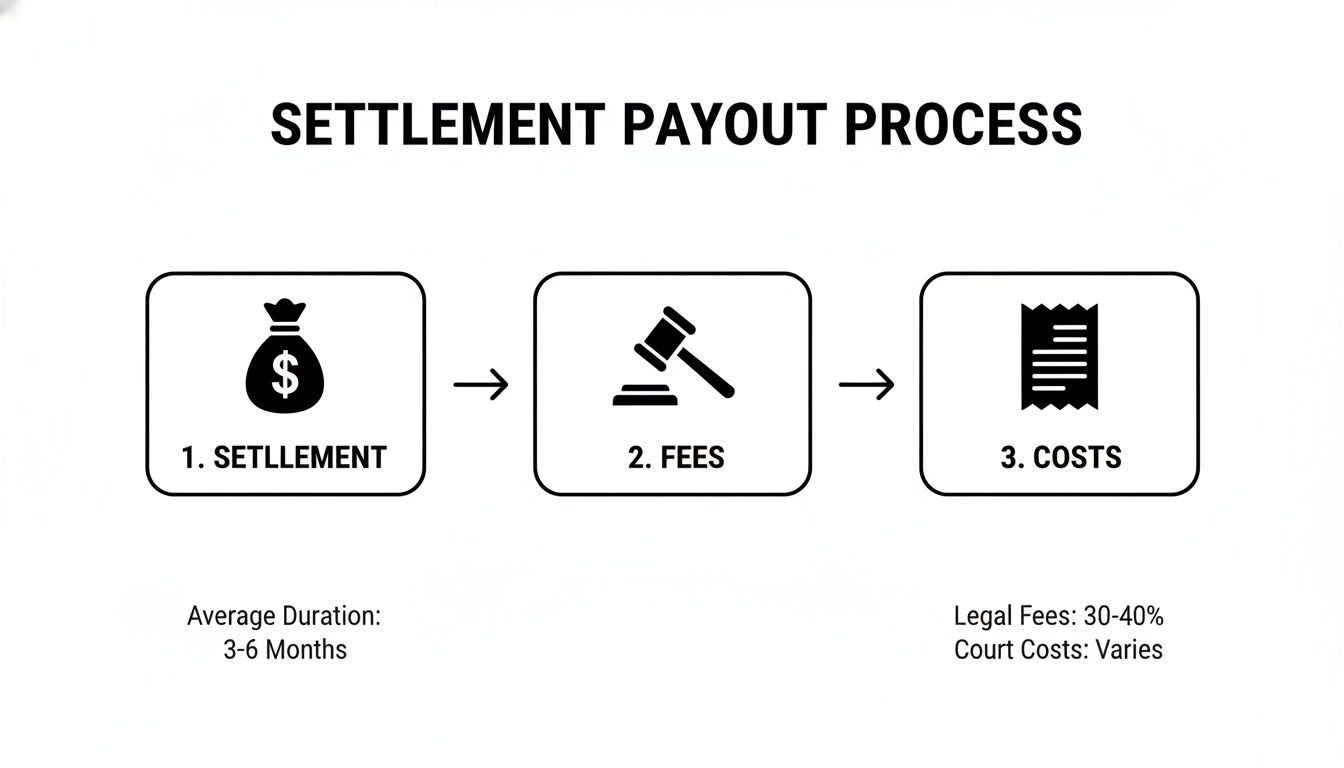
As you can see, the settlement funds are first used to cover the attorney’s fee and the case expenses. After that, we handle any outstanding bills, like medical liens.
Step 1: Start with the Gross Settlement Amount
It all begins with the total amount of money your attorney secured from the at-fault party's insurance company. This is what we call the "gross" settlement.
- Gross Settlement Amount: $100,000
This is the top-line number before a single dollar is deducted. It’s the total compensation for everything you went through—medical bills, lost paychecks, and your pain and suffering.
Step 2: Calculate and Deduct the Attorney's Fee
First things first, we calculate the attorney's contingency fee. As laid out in almost every Texas fee agreement, this percentage is taken from the gross settlement amount.
- Attorney’s Fee Calculation: $100,000 x 33.3% = $33,300
- Remaining Balance: $100,000 - $33,300 = $66,700
After setting aside the fee, we’re left with $66,700. This is the pot of money we'll use to cover the rest of the expenses.
Step 3: Deduct Reimbursable Case Costs
Next up, we reimburse the law firm for the costs it paid out-of-pocket to build your case. Think of expenses like paying for copies of your medical records, court filing fees, or hiring an expert witness.
- Case Costs: $5,000
- Remaining Balance: $66,700 - $5,000 = $61,700
Once the firm is paid back for these direct expenses, the remaining $61,700 is what's available to take care of your medical debts and, finally, what goes to you.
Step 4: Pay Off Medical Liens and Other Debts
Before you get your check, we have to settle any outstanding liens. In our example, the hospital has a $10,000 lien for the treatment they provided. A good lawyer will almost always try to negotiate these liens down, but for the sake of simple math, let's assume it’s paid in full.
- Medical Lien Payment: $10,000
- Final Net Payout to You: $61,700 - $10,000 = $51,700
That final figure, $51,700, is the net amount you’ll receive. It's your take-home recovery after all personal injury lawyer fees, costs, and medical debts are settled.
Key Takeaway: The order of these deductions is crucial. Fees come out first, then costs, then liens. Understanding this sequence is the key to knowing what you'll actually walk away with and avoiding any last-minute surprises.
While our example uses $100,000, every case is different. Statistically, personal injury settlements can range from $3,000 to $75,000, with many car accident cases landing near a median of $40,000. Of course, severe injuries can lead to much, much larger recoveries. To get a better sense of where your case might fall, you can check out our personal injury lawsuit calculator for data from cases similar to yours.
Key Questions to Ask Before Signing a Fee Agreement

When you're presented with a contingency fee agreement, it's easy to feel rushed. But this document is a serious commitment—it’s the financial blueprint for your entire case. Before you put pen to paper, you absolutely must ask the right questions.
Think of your initial consultation as an interview. After all, you’re hiring a professional for a critically important job. Getting total clarity on their personal injury lawyer fees and internal practices from the very beginning is the best way to prevent nasty surprises later on.
A good, reputable lawyer will welcome your questions and give you straight answers. If you get vague responses or feel like you're getting a sales pitch, that’s a major red flag.
The Essential Fee and Cost Checklist
Don't even think about signing an agreement until you have clear, definitive answers to these questions. This is about understanding exactly what you're agreeing to and what your potential financial outcome looks like.
- What is the exact contingency fee percentage? Don't accept a fuzzy range. You need a specific number, like 33.3% or 40%.
- Does that percentage ever change? Many Texas law firms use a "sliding scale." Ask precisely when the fee goes up. Does it increase the moment a lawsuit is filed? Or only when trial prep begins? The timing matters.
- What happens with case costs if we lose? You won't owe attorney fees if there's no recovery, but what about the costs? You need to know if the firm absorbs those expenses or if you’d be on the hook for them.
- Are costs taken out before or after the fee is calculated? We’ve covered this, but it’s so important it’s worth repeating. This one detail can make a big difference in your take-home amount. Confirm they calculate the fee from the gross (total) settlement.
- Can you give me a ballpark estimate for case costs? No one has a crystal ball, but an experienced attorney should be able to give you a reasonable estimate of the costs they anticipate for a case like yours.
- What if I need to fire you, or you withdraw from my case? It’s an uncomfortable question, but a necessary one. Understand the process and any financial strings attached, like an "attorney's lien" that could follow your case.
In Texas, the rules are very clear. The State Bar's Disciplinary Rules of Professional Conduct mandate that all contingency fee agreements must be in writing. They have to plainly state how the fee is determined, including the percentage and how expenses will be handled.
Red Flags to Watch Out For
Just as important as asking the right questions is knowing what warning signs to look for. Trust your gut. If something feels off during your consultation, it probably is.
Be on the lookout for these red flags:
- Vague Language About Expenses: If a lawyer gets cagey or dismissive when you ask about costs, that's a problem. Transparency here is non-negotiable.
- High-Pressure Signing Tactics: You should never feel rushed. A professional will encourage you to take the agreement home, review it, and call back with any other questions you have.
- Guarantees of a Specific Outcome: It is flat-out unethical for an attorney to promise you a specific settlement amount. They can talk about past results or data on similar cases, but guaranteeing a dollar figure is a massive red flag.
- Poor Communication: If the lawyer relies on confusing legal jargon and doesn't bother to explain things in plain English, imagine what communication will be like for the next year or two.
At the end of the day, choosing an attorney isn't just about their fee. It's about finding a partner you can trust—someone who is transparent and genuinely has your back. Asking these direct questions ensures you start that critical relationship on solid ground, with a clear understanding of the agreement between you.
Why Contingency Fees Are a Game-Changer
To really get why personal injury lawyers work the way they do, it helps to zoom out and look at the big picture. We're talking about a massive legal field here—valued at over $60 billion in the U.S. That number is driven by a sobering reality: nearly 40 million Americans need medical attention for injuries every single year. You can dive deeper into these personal injury industry trends if you're curious.
But the contingency fee isn't just a billing method; for most folks, it’s the only key they have to the courthouse door. It’s what makes the whole system fair.
Leveling the Playing Field
Think about it. You’ve just been in a serious car wreck, and now you have to go up against a massive insurance company. They have teams of seasoned lawyers on retainer whose entire job is to minimize or deny your claim. For the average person, who's already drowning in medical bills and unable to work, hiring a lawyer by the hour to fight that kind of battle is simply out of the question.
This is where the contingency fee model changes everything. It completely removes that upfront financial barrier.
You get to hire a top-notch legal team without paying a dime out of your own pocket. Your lawyer fronts all the costs and invests all the time and resources into building your case. It puts you on equal footing with the insurance giants, ensuring your case is decided on the facts, not on who has more money.
The contingency fee system ensures that justice isn't a luxury item reserved for the wealthy. It gives you the power to stand up to powerful opponents and demand what you're owed.
At the end of the day, this structure is what allows you to get the resources you need to heal and put your life back together. It’s helpful to reframe how you see the fee—it’s not just a percentage taken from your settlement, but the critical investment that made your settlement possible in the first place.
Frequently Asked Questions About Texas Lawyer Fees
Even with all this information, you probably still have a few questions rolling around in your head. That's completely normal. Let's tackle some of the most common questions we hear so you can feel totally clear on how the money side of things works.
Can I Negotiate the Contingency Fee Percentage?
Yes, you can, but it’s not always a given. The best chance for negotiating a lower percentage is in cases where the potential payout is exceptionally high or when the other party's fault is crystal clear from the get-go. These scenarios lower the law firm's risk, which might give them some wiggle room.
Keep in mind, though, that the standard 33.3% to 40% fee isn't just a random number. It reflects the immense risk, time, and upfront money your lawyer pours into your case. So while you can always ask, don’t be surprised if a firm sticks to its standard rate. In a way, their willingness to take your case at their normal rate shows they believe in its strength.
What Happens If I Lose My Personal Injury Case?
This is where the contingency fee model is a real lifesaver. If your attorney doesn't win you a settlement or a jury verdict, you owe them zero in attorney fees. All the hours they spent working on your case were their gamble, not yours.
The only thing to watch out for is case costs. Your fee agreement should spell out whether you're on the hook for those out-of-pocket expenses if the case doesn't succeed. Many Texas firms will write off these costs if you lose, but you absolutely have to confirm that detail in your contract before you sign anything.
How Long Until I Get Paid After a Settlement?
Once everyone signs on the dotted line, it typically takes about four to six weeks to get your money. It can feel like a long wait, but there’s a lot of important administrative work happening behind the scenes.
Here's a quick rundown of what's going on during that time:
- The insurance company cuts and sends the settlement check to your lawyer.
- Your lawyer deposits that check into a special trust account, where it has to clear.
- They then use those funds to pay off any outstanding medical liens and case expenses.
- Finally, they cut a check for your share of the money and send it your way.
If you want a deeper dive into this process, check out our guide on how long a personal injury settlement takes for a step-by-step timeline.
Are Personal Injury Lawyer Fees Tax Deductible?
For most Texas personal injury cases, the answer is no. The IRS doesn't usually treat money you receive for physical injuries or pain and suffering as taxable income. Since the settlement itself isn't taxed, you can't deduct the legal fees you paid to get it.
The rules can change if part of your settlement is for things that are taxable, like lost wages or punitive damages. In that situation, you might be able to deduct a portion of the attorney's fees. Tax law is tricky, so it’s always best to talk to a tax professional who can give you advice based on your specific circumstances.
Don't walk into negotiations blind. Verdictly gives you access to real data from thousands of Texas motor vehicle verdicts and settlements, showing you what cases like yours are actually worth. Level the playing field and argue from a position of strength. Explore real case outcomes at https://verdictly.co.