

Using a Personal Injury Lawsuit Calculator
See how a personal injury lawsuit calculator works. Learn to estimate your potential settlement by understanding damages, liability, and key adjustment factors.
If you've ever wondered what a personal injury claim might be worth, you've probably stumbled across an online personal injury lawsuit calculator. Think of these tools less like a bank statement and more like a financial weather forecast—they give you a probable range, not a guaranteed outcome. Their main job is to take all the ways you've suffered a loss and translate that into a starting dollar figure.
How a Personal Injury Lawsuit Calculator Works

At its core, a calculator is a data-crunching tool. You feed it the key details of your accident and injuries, and it applies a standard formula to spit out a ballpark compensation number. The goal is to give you a basic grasp of what your claim could be worth before you ever sit down to negotiate with an insurance adjuster.
It’s absolutely critical to remember this is just an estimate. The real world of personal injury law is messy and far more nuanced than any online form can ever capture. Things like the quality of your evidence, your lawyer's strategy, and even how a jury might perceive your case can swing the final amount dramatically.
The Basic Calculation Framework
Most calculators start with the easy stuff: your tangible, out-of-pocket expenses. In legal terms, these are called economic damages, and they form the solid foundation of your claim's value. From there, the calculator has to do the tricky work of putting a price tag on the intangible impacts of your injury.
Let's look at the core inputs that go into this calculation.
Core Inputs for a Settlement Calculation
The table below breaks down the essential pieces of information a calculator needs to generate a claim estimate. These are the building blocks for any personal injury valuation.
| Input Category | What It Includes | Its Role in the Calculation |
|---|---|---|
| Medical Expenses | Ambulance rides, ER visits, hospital stays, surgeries, physical therapy, prescriptions, and any future care you'll need. | This is the hard-number foundation. It's often used as the base for calculating pain and suffering. |
| Lost Income | Wages you lost while out of work. It can also project lost future earning potential if the injury is long-term or permanent. | This quantifies the direct financial hit your injury had on your ability to work and provide. |
| Pain and Suffering | Physical pain, emotional distress, anxiety, loss of enjoyment of life, and other non-tangible impacts. | This is the most subjective part. It’s typically calculated by applying a multiplier (usually 1.5 to 5) to your total medical costs. |
Each piece of data helps build a more complete picture of your losses, moving from concrete bills to the more abstract, but very real, human cost of an injury.
A calculator simplifies a complex legal and economic reality into a digestible number. Its primary value is educational, helping you frame expectations and organize the key facts of your case before speaking with an attorney.
The Bigger Picture in Personal Injury Law
These calculations matter because they are the engine of a huge economic sector. The U.S. personal injury law market is on track to be worth around $61.7 billion in 2025. That number is fueled by the nearly 39.5 million Americans who need medical help for injuries every year.
What's really telling is that about 95% of these cases never see the inside of a courtroom; they're resolved through pre-trial settlements. This statistic underscores just how vital it is to have an accurate starting valuation when heading into negotiations. For a deeper dive, you can explore more personal injury statistics and industry trends to understand the full scope of the market.
Tallying Up Your Tangible Financial Losses
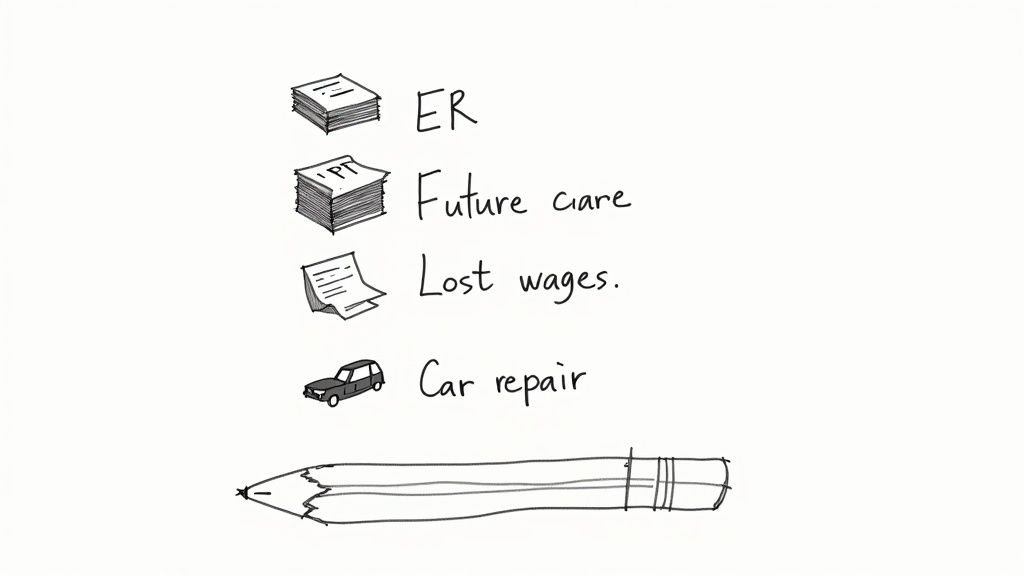
Before we can even begin to talk about the complex idea of "pain and suffering," we have to start with the cold, hard numbers. In legal terms, these are called economic damages, and they represent every single dollar you've lost or had to spend because of someone else's negligence.
Think of it like gathering up every receipt after a house fire. Each piece of paper proves a real, tangible financial hit. This part of the process is all about meticulous record-keeping, as your final tally becomes the solid ground on which the rest of your claim is built. It's the most objective part, backed by invoices and pay stubs that are tough for an insurance adjuster to argue with.
Itemizing Your Medical Expenses
For most personal injury cases, the biggest chunk of economic damages comes from medical bills. And it’s rarely just the initial trip to the ER. To get a true picture of the cost, you have to account for every healthcare expense, both what you’ve already paid and what you’ll likely face down the road.
Your list should capture the full spectrum of care:
- Emergency Services: Ambulance rides, emergency room treatment, and any initial hospital admission fees.
- Hospital Stays and Surgeries: The cost of inpatient care, operations, and fees for surgeons or anesthesiologists.
- Ongoing Treatment: All those follow-up appointments, physical or occupational therapy sessions, and prescription drug costs.
- Medical Equipment: Anything you needed to get around or function, like crutches, a wheelchair, or specialized braces.
It’s crucial to think about the future, too. If your doctor confirms you’ll need another surgery, long-term therapy, or lifelong medication, those projected costs are a valid part of your claim. Getting an expert medical opinion to estimate these future expenses is often necessary to ensure your settlement covers your entire recovery, not just the bills already sitting on your kitchen table.
Calculating Lost Wages and Earning Capacity
An injury doesn’t just send you to the doctor; it can slam the brakes on your income. Figuring out your lost wages is usually pretty straightforward—it's the money you weren't able to earn while you were out recovering.
To get the full amount, you need to track:
- Time Missed From Work: This includes the initial time off right after the accident, plus any later days you had to take for follow-up appointments or therapy.
- Used Sick Days and Vacation Time: Did you have to burn through your paid time off? That's a real financial loss and absolutely counts.
But what if the injury is more serious? It can permanently damage your future earning capacity, which is your ability to make a living over your entire career. If you can no longer do your old job and have to take a lower-paying one, the difference in your potential lifetime earnings is a massive part of your damages. This often requires bringing in a vocational expert to crunch the numbers. For a deeper dive, our guide explains all the types of damages in personal injury cases you might be able to claim.
Accounting for Other Out-of-Pocket Costs
Finally, economic damages cover all the other miscellaneous expenses that popped up because of the accident. They might seem small next to a hospital bill, but they can add up fast.
The goal here is to paint a complete financial picture of the accident's fallout. No legitimate expense is too small to include—each one adds to the true total and makes your case stronger.
Common out-of-pocket costs often include:
- Property Damage: The cost to repair or replace your car, plus anything inside it that was destroyed, like a laptop or phone.
- Travel Expenses: Mileage, parking fees, or rideshare costs for all those trips to and from doctor’s offices.
- Home Modification: The cost to install ramps, grab bars, or other accessibility features if your injury leaves you with a long-term disability.
By carefully tracking and documenting every single expense, you establish a clear, evidence-based number. This figure isn’t just a number; it’s the essential starting point for any settlement negotiation.
Putting a Number on Pain and Suffering
It's one thing to add up medical bills and lost paychecks. That's just math. But how do you put a price tag on the actual human cost of an injury? This is where a personal injury lawsuit calculator comes into play, attempting to quantify the very real, but abstract, impact the accident had on your life.
These are what lawyers call non-economic damages, and they represent the personal toll of what you've been through. If your economic damages are the black-and-white receipts of your case, think of your non-economic damages as the full-color story behind them. They cover everything from the physical pain you endured to the emotional distress of recovery and even the loss of simple joys, like playing with your kids or going for a run. This is almost always the most contested part of any claim because, frankly, it's entirely subjective.
The Multiplier Method Explained
To bring some structure to this abstract concept, insurance adjusters and attorneys often turn to a guideline known as the multiplier method. It’s a simple formula, but it’s designed to translate your tangible financial losses into a reasonable figure for your intangible suffering.
The process starts with your total economic damages—that’s the sum of your medical bills, lost wages, and any other direct costs. That total is then multiplied by a specific value, which usually falls somewhere between 1.5 and 5.
The thinking here is that the amount of pain and suffering you went through is generally proportional to the severity of your injuries and how much it cost to treat them. A minor fender-bender with a few hundred bucks in chiropractor bills just isn't going to justify the same multiplier as a life-altering injury that requires multiple surgeries and years of rehab.
The multiplier method isn't an exact science. It's a widely accepted starting point for negotiation, meant to anchor the subjective value of pain and suffering to the objective, verifiable costs of the injury.
Choosing the right multiplier is where the real art of negotiation begins. Several key factors will push that number up or down.
- Severity of the Injury: A permanent or disfiguring injury, like a spinal cord injury or severe burns, is going to command a much higher multiplier than a sprain that heals in a few weeks.
- Length and Nature of Recovery: A long, painful, and invasive recovery process—think surgeries, extensive physical therapy, and chronic pain—justifies a higher number.
- Impact on Daily Life: How much has the injury truly disrupted your life? If you can no longer enjoy your hobbies, handle daily chores, or connect with your family like you used to, the multiplier needs to reflect that loss.
- Psychological Trauma: Any documented emotional distress, such as anxiety, depression, or PTSD stemming from the accident, will also push the multiplier up.
To really get a handle on your claim's potential, you need to understand all the pieces that make up non-economic damages. For a much deeper dive, you can explore our guide on what non-economic damages cover to see how these factors are weighed.
How State Laws Influence Valuations
The value of a personal injury claim isn't just about the facts of your case; it's also heavily influenced by where the accident happened. Personal injury lawsuit calculators often rely on historical data and settlement ranges to generate estimates. However, these figures can vary dramatically from one state to another due to differences in tort laws and damage caps.
For instance, in 2024, the average claim payout in New York was approximately $565,000, while in Florida, the average was closer to $304,000. This massive gap is often due to state-specific legal frameworks, such as caps on how much can be awarded for non-economic damages. To get a better sense of these trends, you can discover more insights about personal injury law statistics on Clio.com and see how location plays a critical role.
Applying the Multiplier in a Real Scenario
Let’s walk through a quick example to see how this all comes together. Imagine someone has racked up $20,000 in total economic damages (medical bills and lost wages) after a serious car accident.
Their injuries included a broken leg that needed surgery and a six-month recovery, causing significant pain and keeping them from their active lifestyle. Given the severity and the long road to recovery, their attorney might argue for a multiplier of 3.
The calculation is straightforward: $20,000 (Economic Damages) x 3 (Multiplier) = $60,000 (Non-Economic Damages)
In this case, the total estimated settlement value before any other adjustments would be $80,000 ($20,000 for the hard costs + $60,000 for pain and suffering). This final figure gives them a solid, defensible number to bring to the negotiation table.
How Fault Can Reduce Your Settlement
So you've tallied up your medical bills and used a multiplier to estimate your pain and suffering. You might think you've landed on a final number, but there's a huge piece of the puzzle missing: your own role in what happened. In the real world of personal injury law, it's rarely a clean-cut case of one blameless victim and one person who's 100% wrong. Often, the fault is shared.
This is where the legal concept of comparative negligence comes in, and it can take a serious bite out of your final payout. Picture your potential settlement as a whole pie. If an insurance adjuster or a jury decides you were partly to blame for the accident, they will slice away a piece of that pie equal to your percentage of fault.
For instance, let's say your total damages add up to $100,000. If you're found to be 20% at fault, your maximum recovery instantly drops to $80,000. This isn't just a suggestion; it's the law in many states, and insurance companies count on it to slash what they have to pay.
Understanding Your State's Fault Rules
How fault gets handled is completely dependent on where the accident happened. States have different systems for this, and the one you fall under can make or break your case. This isn't just a technicality—it can be the difference between getting a check and getting nothing.
Most states use one of two main systems for comparative negligence:
- Pure Comparative Fault: In these states, you can recover damages no matter how much you were at fault. It sounds a bit wild, but even if a jury finds you 99% responsible, you could still technically sue the other party for that remaining 1% of your damages.
- Modified Comparative Fault: This is the far more common approach, and it comes with a strict cutoff. Here, you can only get paid if your fault is below a certain line—usually 50% or 51%. If your share of the blame crosses that threshold, you walk away with zero.
It's absolutely critical to know the specific negligence laws for your state. This single rule dictates whether you get a reduced settlement or no settlement at all. Any personal injury calculator that ignores this will give you a dangerously misleading number.
How Texas Handles Shared Fault
Texas is a modified comparative fault state, with what's known as a 51% bar. The official term is the "proportionate responsibility" statute.
Here's how it plays out for a claim in Texas:
- You can recover money as long as you are 50% or less at fault.
- Your final award is reduced by your exact percentage of fault.
- If you are found to be 51% or more responsible, you get nothing. The door slams shut.
Let's use a real-world example. Imagine a car wreck in Dallas where the total damages come out to $50,000. The other driver blew through a stop sign, but you happened to be driving a few miles over the speed limit. A jury might decide you were 10% at fault.
Under Texas law, your $50,000 award would be cut by that 10%, so you would recover $45,000. But let's change the facts a bit. If you were found 51% at fault—maybe you were texting at the time of the crash—that potential $50,000 award completely vanishes. It becomes $0.
For a deeper dive into these rules, you can learn more about how comparative negligence in Texas works and what it means for your settlement.
Why a Calculator Is Only a Starting Point
A personal injury calculator gives you a number, a valuable starting point for understanding what your claim could be worth. But it’s crucial to see that number for what it is: a baseline.
Think of it like using Zillow to estimate your home's value. The algorithm gives you a ballpark figure based on square footage and recent sales, but it can't see the custom-built kitchen, the beautiful landscaping, or the crack in the foundation. It provides data, not the full picture.
In the same way, an automated calculator works with clean math, but personal injury claims are almost never clean. The real value is tied up in the messy, human details that an algorithm can't possibly grasp.
The Variables a Calculator Can't Measure
The number a calculator spits out is just the beginning of the story. The final chapter—the actual settlement amount—is written by factors that can't be entered into a digital form. These are the nuances that skilled attorneys and insurance adjusters spend their careers learning to evaluate.
Here are just a few of the critical elements that will have a huge impact on your final recovery:
- Witness Credibility: Is your key witness confident, clear, and likable? Or do they seem hesitant and unsure? A jury's perception of a witness can make or break a case.
- Your Attorney's Reputation: The lawyer you hire matters. An attorney known for being a tough negotiator who isn’t afraid to go to trial often gets much higher settlement offers from insurance companies looking to avoid a fight.
- Your Own Jury Appeal: How will you come across to a jury? Your personal story, your demeanor, and how genuinely you can communicate your suffering play a massive role in how a jury might decide to value your claim.
- The Insurance Company's Playbook: Some insurance carriers are notorious for fighting every claim tooth and nail, while others are more pragmatic. Your opponent's reputation for playing hardball (or not) is a big factor.
A calculator provides a quantitative estimate based on data. The final settlement, however, is a qualitative outcome, shaped by human perception, legal strategy, and the unique dynamics of your specific case.
Local Court and Jury Reputations
Another blind spot for any online calculator is the local legal landscape. Where you file your lawsuit can make a monumental difference.
Some counties in Texas are known for being very plaintiff-friendly, with juries that historically return high-dollar verdicts. On the flip side, more conservative jurisdictions might be known for much smaller awards. Attorneys and insurance companies track this data obsessively—they call it "venue value."
A case with identical facts could be worth 50% more or less just by crossing a county line. That's a critical piece of local knowledge a calculator simply doesn't have.
So, treat the calculator's estimate as an educational tool. It's fantastic for organizing your damages and getting a handle on the basic math. But use that number as the foundation for a much deeper conversation with an experienced attorney. They are the ones who can factor in all these unquantifiable elements and give you a truly realistic assessment of what your case is really worth.
A Step-by-Step Settlement Calculation Example
To really understand how these numbers come together, let's walk through a realistic scenario. We'll follow "Alex," a driver in Texas who was recently in a car wreck. This example will show you how a baseline figure from a personal injury lawsuit calculator is just the beginning of the story.
Step 1: Tallying the Economic Damages
First things first, you have to add up all the tangible, black-and-white losses. In this case, Alex's accident resulted in a serious fracture, which means the bills started piling up fast.
After gathering every receipt and pay stub, Alex's hard costs look like this:
- Medical Expenses: $25,000 (this covers the emergency room visit, surgery, and all the physical therapy that followed)
- Lost Income: $10,000 (for the time Alex was unable to work during the initial recovery)
- Vehicle Repair Costs: $5,000 (to get the car back on the road)
This gives Alex a total of $40,000 in economic damages. This number is the solid, evidence-backed foundation for the entire claim.
Step 2: Calculating Pain and Suffering
Next comes the tricky part: putting a number on the non-economic damages. Alex's fracture was severe, leading to a painful six-month recovery that completely upended daily life. It’s more than just the bills; it's the experience itself.
Given the seriousness of the injury and that long recovery, a multiplier of 3 is a fair place to start. We apply this to the medical costs to get a reasonable estimate for the pain and suffering endured.
Calculation: $25,000 (Medical Costs) x 3 (Multiplier) = $75,000
When we add this to the economic damages, Alex’s initial estimated claim value now stands at $115,000 ($40,000 + $75,000).
The process below shows how these simple inputs get refined by legal realities to land on a final, more accurate number.

As you can see, a raw calculation is just step one. The real work happens when you factor in the critical external variables that shape the final outcome.
Step 3: Adjusting for Shared Fault
Here’s where things get interesting. The police report concluded that while the other driver absolutely ran a stop sign, Alex was speeding at the time of the crash. Under Texas’s modified comparative fault rules, Alex was found to be 10% responsible for the accident.
This is a huge detail, and it directly reduces the potential settlement.
Calculation: $115,000 (Total Damages) - 10% ($11,500) = $103,500
This adjustment for shared fault is one of the most important steps in the whole process. It's the perfect example of why a calculator's initial output is a starting point, not a guaranteed check.
To make this flow clearer, here’s a table breaking down how the claim value evolves from raw numbers to a final, adjusted estimate.
Hypothetical Texas Car Accident Calculation
| Calculation Stage | Action and Details | Sample Value |
|---|---|---|
| 1. Economic Damages | Sum of all verifiable financial losses (medical bills, lost pay, property damage). | $40,000 |
| 2. Non-Economic Damages | Medical costs multiplied by a "pain and suffering" multiplier (3x in this case). | $75,000 |
| 3. Initial Claim Value | Combining the economic and non-economic damages for a pre-adjustment total. | $115,000 |
| 4. Liability Adjustment | Reducing the total by the percentage of shared fault (10% for Alex). | -$11,500 |
| 5. Final Estimated Value | The final, defensible claim value after all adjustments have been made. | $103,500 |
This step-by-step breakdown shows how different factors build upon and modify each other to arrive at a much more realistic figure than a simple sum of bills.
The Final Settlement Range
After running all the numbers and making the necessary adjustments, Alex now has a strong, defensible claim valuation of $103,500. This figure isn't a final demand; it's the anchor point for negotiation.
An attorney would likely use this to establish a negotiation range—say, somewhere between $95,000 and $110,000—to create room for the inevitable back-and-forth with the insurance company. This whole exercise shows exactly how a calculated estimate gives you the strategic foundation you need to walk into settlement talks with confidence.
Common Questions About Injury Calculators
Once you get the hang of the inputs, you'll probably still have a few questions about how these personal injury calculators work in the real world. Let's tackle some of the most common ones we hear from people trying to figure out what their claim might be worth.
Is a Calculator's Estimate Legally Binding?
Not a chance. Think of a calculator's output as an educational estimate, not a contract. It is not a legally binding offer, and an insurance company has absolutely no obligation to match a number you got from a website.
The best way to see it is as a well-informed starting point. It gives you a ballpark figure to begin a conversation, helping you set realistic expectations and organize your claim. But it’s not an official price tag.
Why Is My Calculator Estimate So Different from My Friend's?
This is a big one. It's because no two accidents are ever truly the same. Even what seems like a minor difference between two cases can lead to a massive swing in the final settlement amount.
Just a few of the things that can dramatically change the value include:
- Severity of the Injury: A herniated disc that requires spinal fusion surgery is in a completely different league than a simple case of whiplash.
- Total Medical Bills: The higher the documented medical costs, the higher the starting point for calculating damages.
- State-Specific Laws: Every state has its own rules about things like shared fault (comparative negligence) and caps on damages, which can drastically alter an outcome.
- Who Was At Fault: If you're found to be 20% at fault, you can expect your final award to be reduced by that same percentage.
Because of all these moving parts, comparing your case to someone else's is like comparing apples and oranges.
The only reliable way to use a calculator is to focus on your specific details. Trying to benchmark your situation against another person's story without knowing every single fact is a recipe for setting yourself up for disappointment or, just as bad, undervaluing your claim.
Can I Use This Estimate to Negotiate By Myself?
You technically can, but for any kind of serious injury, it’s a risky move. A calculator gives you a number, which is a great start. What it doesn't give you is the legal strategy, knowledge of court procedures, or the battle-tested negotiation skills needed to face off against a professional insurance adjuster.
Remember, the adjuster's entire job is to pay out as little as possible. They are trained to find weaknesses in your claim and know the law inside and out. Your estimate is a powerful piece of information, but it's most powerful in the hands of a skilled attorney who can build a rock-solid legal argument to back it up.
Ready to see what real Texas motor vehicle cases are actually worth? Verdictly gives you a direct line into a database of actual verdicts and settlements. You can filter by injury, county, and accident type to empower your negotiations with hard data. Explore our case database at https://verdictly.co.
Related Posts

How Are Car Accident Settlements Calculated: Your Guide to Fair Payouts
Discover how are car accident settlements calculated and what factors like medical costs, lost wages, and pain and suffering affect your final payout.