
How long does personal injury settlement take in Texas?
Discover how long does personal injury settlement take and what factors influence the Texas timeline. Clear, actionable insights to help you plan.
When you're hurt, dealing with the aftermath of an accident, the last thing you need is more uncertainty. You're probably asking, "How long is this going to take?" While there's no magic number, personal injury settlements can take anywhere from a few months for simple cases to a few years for more complicated ones.
Your Guide to Texas Personal Injury Settlement Timelines
Trying to navigate a personal injury claim can feel like you've been dropped in a new city without a map. You know where you need to end up—a fair settlement—but the route and the ETA are a total mystery. With medical bills piling up and lost paychecks creating stress, having a realistic timeline isn't just helpful; it's essential.
Think of this guide as your GPS. We'll break down the entire journey, point out the major roadblocks that can slow things down, and give you some data-backed timelines to help you know what to expect.
Understanding the Timeline Spectrum
If there's one thing that dictates how long your case will take, it's the severity of your injuries. A minor rear-end collision where you recover from whiplash in a few weeks will wrap up much faster than a serious crash that requires surgery and long-term physical therapy.
- Minor Injuries: When liability is clear and the injuries are straightforward, these cases can often be resolved in under a year.
- Moderate to Severe Injuries: Cases involving more significant harm demand a lot more medical treatment and a mountain of paperwork, which naturally draws out the timeline.
- Complex Cases: If there's a fight over who's at fault, or if multiple parties are involved, things can get complicated and drag on for several years.
A recent analysis of personal injury claims really puts this into perspective. For minor injuries like cuts and burns, the average settlement time was 10 to 13.5 months. Cases with more moderate injuries, like broken bones, took about 12 to 16 months. And for the most complex claims, like those involving traumatic brain injuries, the timeline could stretch from 33 months to over four years.
For a quick reference, here's how timelines often break down by the type of injury.
Average Personal Injury Settlement Timelines by Injury Type
| Injury Type | Average Settlement Timeline |
|---|---|
| Minor (e.g., Whiplash, Bruises) | 6 - 12 months |
| Moderate (e.g., Simple Fractures) | 12 - 18 months |
| Serious (e.g., Surgery Required) | 18 - 30 months |
| Catastrophic (e.g., TBI, Spinal Cord) | 24 - 48+ months |
This table gives you a general idea, but remember that every case is unique and these are just averages. The goal is always to get the full picture of your damages before settling.
The chart below gives you a great visual of how these timelines expand as the injuries get more serious.
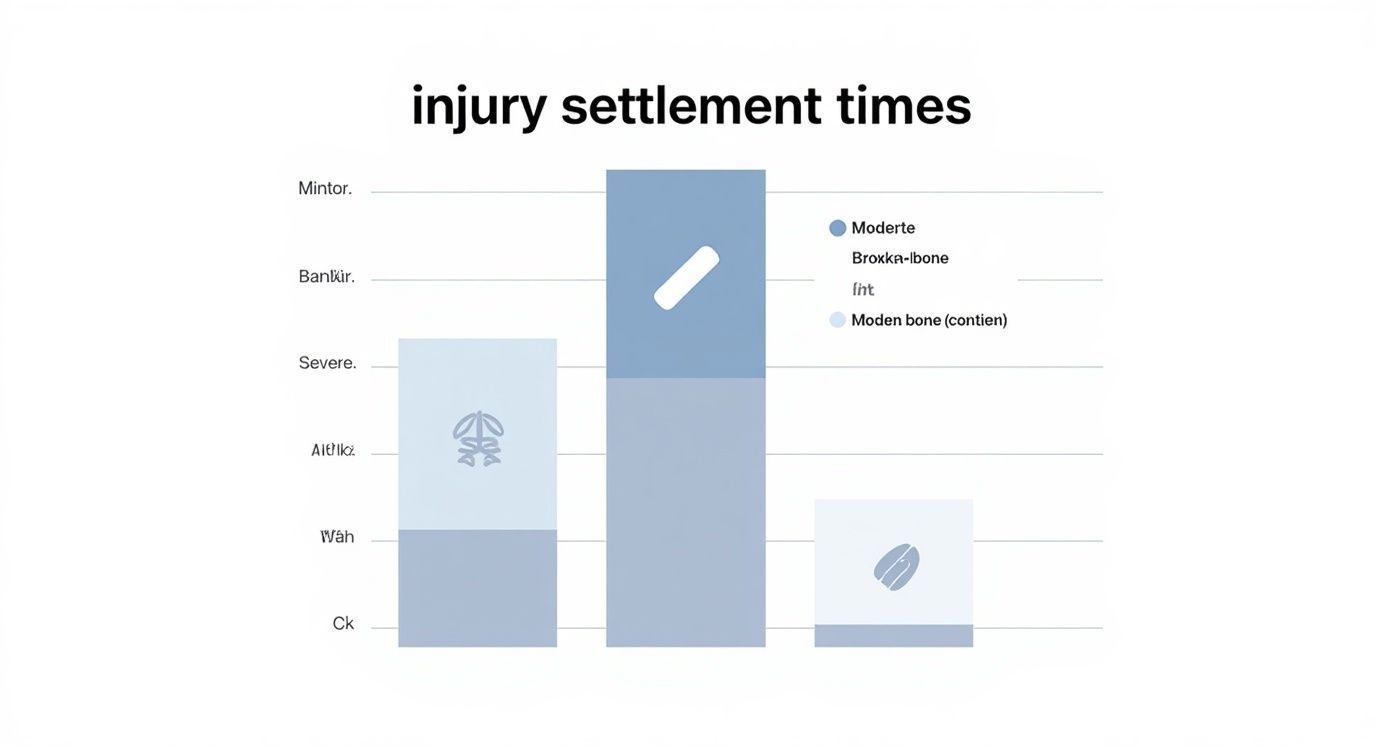
As you can see, the more complex your medical situation is, the longer it takes to gather all the necessary proof and fight for a fair number. This extra time is crucial. It ensures that every single damage—both what you've already lost and what you'll need in the future—is fully accounted for. For more specific insights, you can review some real Texas motor vehicle accident data to see how these timelines play out in actual cases.
The Four Key Stages of a Personal Injury Claim

When people ask how long a settlement takes, the real answer is that it depends on the journey. A personal injury claim isn't a single event; it's a process with distinct stages. Think of it like a train ride—you have to pass through each station before you get to your final stop.
Every case moves through these phases, and each one has its own timeline and purpose. Let's break down this journey into four key stages so you can see exactly where you are in the process and what's coming next.
Stage 1: Medical Treatment and Reaching Maximum Medical Improvement
This first stage is all about you—your health and your recovery. It’s also often the longest part of the journey. Before your attorney can even think about negotiating a fair settlement, you need to reach what's called Maximum Medical Improvement (MMI).
MMI doesn't mean you're 100% healed. It just means your medical condition has stabilized to the point where your doctors have a clear picture of your long-term prognosis. They know what future care you'll need, if any, and what permanent limitations you might have.
Why is this so crucial? Settling a case before you reach MMI is a massive gamble. You might accept a check that doesn't come close to covering a future surgery or the lifelong physical therapy you didn't know you'd need. For minor injuries, this stage might take a few months. For serious ones, it can easily stretch beyond a year.
Why Reaching MMI Is Non-Negotiable "Settling a claim before you reach Maximum Medical Improvement is like selling a house before the inspection is finished. You don't know its true value or what future repairs might cost. Patience during this stage ensures your final settlement reflects the total impact of the injury on your life."
Stage 2: Investigation and Evidence Gathering
While you're focused on healing, your legal team gets to work building the foundation of your case. This investigation happens at the same time as your medical treatment and involves digging up every piece of evidence needed to prove who was at fault and document what you've lost.
This isn't a quick process. It's a detailed, methodical effort to build an ironclad case file. It includes:
- Collecting Records: We're talking every single medical bill, doctor's note, and treatment summary.
- Documenting Lost Wages: This means getting official proof of your income and meticulously tracking every single workday you've missed.
- Gathering Evidence: Your team will secure the official police report, track down and interview witnesses, and find any photos or video footage of the incident.
- Consulting Experts: For more complicated cases, this might involve bringing in accident reconstructionists or medical specialists to provide expert testimony.
All this behind-the-scenes work ensures that when we finally sit down to negotiate, your claim is backed by undeniable proof.
Stage 3: Negotiation and the Demand Letter
Once you've reached MMI and all the evidence is in hand, the case shifts into the active negotiation phase. It all kicks off when your attorney drafts and sends a formal demand letter to the at-fault party's insurance company. This letter is our opening move—the first shot fired in the settlement battle.
This isn't just a simple letter. It’s a comprehensive package that lays out the facts, proves the other party’s liability, itemizes all your damages—from medical bills and lost income to pain and suffering—and states the total compensation you're demanding.
The insurance adjuster will review the demand and fire back with an initial offer. Nine times out of ten, it’s a lowball number. This is where the real back-and-forth begins. Your attorney will counter their offer, using the evidence to dismantle their arguments and justify your valuation. This dance can last a few weeks or drag on for several months, all depending on how reasonable the insurance company decides to be.
Stage 4: Final Resolution and Disbursement
This is the final station on the journey, where your case officially comes to a close. If the negotiations were successful, both sides agree on a settlement figure. You’ll sign a release form—a legal document where you agree not to take any further legal action in exchange for the payment.
The path to a personal injury settlement has many steps, which is why a case can take anywhere from a few months to a few years. That first year after an accident is often spent focused on your health, letting your medical needs play out so we can fully document them. This is essential, as insurance companies require this deep dive to evaluate your claim. You can find more insights on how these stages affect your personal injury timeline on lowmanlawfirm.com.
Once the release is signed, the insurer sends the settlement check to your attorney's office. The funds are deposited into a special trust account. From there, your lawyer pays off any outstanding liens (like hospital bills or health insurance reimbursements), deducts their legal fees, and then cuts you a check for the rest. This final administrative part of the process usually takes between two to six weeks.
Factors That Can Speed Up or Slow Down Your Settlement
https://www.youtube.com/embed/SKJEB5AwmGc
It’s the question every client asks: “How long will this take?” And the honest answer is, it depends. Not all personal injury cases move at the same speed. Think of it like two cars headed to the same destination—one might hit every green light while the other gets stuck in traffic. Your case is no different.
Certain things act like green lights, pushing your case forward, while others are frustrating red lights, causing significant delays. Getting a handle on these variables is the key to setting realistic expectations and understanding why some cases wrap up in a few months while others can stretch on for years.
Let's break down the biggest factors that control the pace of your claim.
The Role of Clear Liability
This is the big one. The single most important factor for a speedy settlement is undisputed liability. When it's obvious who caused the accident, there’s simply less for the insurance company to fight about.
Imagine you were rear-ended at a stoplight, and the other driver got a ticket at the scene. The evidence of fault is overwhelming, leaving the insurer with very little room to deny responsibility. That clarity allows everyone to skip the "who did it" debate and move straight to negotiating the amount of your damages.
On the other hand, things can grind to a halt when liability is a mess. We see this all the time in cases like:
- Intersection Accidents: He-said, she-said arguments over who had the green light can turn into a major investigation, often requiring witness interviews or a search for traffic camera footage.
- Multi-Car Pileups: Figuring out the chain reaction and assigning a percentage of fault to each driver is a complicated puzzle that takes time to solve.
- Shared Fault Arguments: If the insurance company claims you were even partially to blame, it throws a huge wrench in the works and becomes a major point of contention.
When fault is up in the air, the timeline gets stretched out. Both sides have to dig in, gather evidence, and build a case just to establish who was responsible.
The Bottleneck of Disputed Fault "When liability is unclear, the entire settlement process can get stuck. It becomes a battle of evidence and interpretation, and until fault is established, meaningful negotiations about compensation can't even begin. This is often the primary reason a case timeline extends beyond the average."
Injury Severity and Medical Treatment
The seriousness of your injuries plays a huge role in the timeline. The simple truth is, you can’t resolve a case until you know the full extent of the damage. A quick settlement is only possible when your medical future is clear and stable.
Minor, straightforward injuries often lead to faster resolutions. If you suffered whiplash that got better after a few months of physical therapy, your attorney can gather all the bills and records fairly quickly. Once you’ve made a full recovery, they have a complete picture of your damages to present to the insurer.
Serious or complex injuries, however, will always lengthen the process. Your legal team has to wait until you reach what’s called Maximum Medical Improvement (MMI)—the point where you’re either fully healed or your condition has stabilized as much as it’s going to. Settling before you reach MMI is a huge mistake, as you could be accepting a fraction of what you truly need.
These are some of the medical issues that will definitely extend the timeline:
- Needing Surgery: An operation immediately adds months of recovery, rehab, and follow-up appointments to your case timeline.
- Long-Term Care: If you need ongoing physical therapy, pain management, or home health care, it takes time to accurately calculate these future costs.
- Permanent Disability: Assessing the lifelong financial fallout of a permanent injury is a complex process that often requires reports from medical and vocational experts.
Patience is absolutely critical here. Rushing to the finish line might feel tempting, but waiting for a complete medical picture ensures your settlement covers all of your future needs, not just your past bills.
The Insurance Company's Approach
Finally, the attitude of the at-fault driver's insurance company is a real wild card. Some insurers negotiate in good faith to get claims resolved fairly. Others are notorious for dragging their feet and using delay tactics to wear you down.
An insurance adjuster might slow-walk your claim by:
- Asking for duplicate or unnecessary documents.
- Taking forever to respond to your attorney’s emails and phone calls.
- Making one lowball offer after another, completely ignoring the facts of your case.
- Fighting you on the cost or necessity of your medical care without a legitimate reason.
These strategies are designed to make you so frustrated that you’ll take a low offer just to be done with it all. This is exactly why having an experienced personal injury lawyer is so important. A good attorney has seen these games a hundred times before. They know how to apply legal pressure to counter the delays, keep the case moving, and fight for a resolution that is both timely and fair.
A Realistic Timeline for Texas Car Accident Claims

So, what does this all mean for your case? Let's ground these ideas in the real world. The most common personal injury claim in Texas is the motor vehicle accident, which gives us the perfect lens to see how these timelines actually play out.
By walking through two very different crash scenarios—one simple, one complicated—you'll get a much better feel for how all the variables we've talked about can either speed things up or bring them to a grinding halt.
Scenario 1: The Straightforward Rear-End Collision
Picture this: you're stopped at a red light in Dallas when another car slams into you from behind. The other driver is ticketed on the spot—fault is a non-issue. Your injuries are thankfully minor, mostly whiplash and bruising, and you're back to normal after three months of physical therapy.
This is what we'd call a "straightforward" case. The path to settlement is usually pretty clear.
- Liability is Clear: There’s no debate about who caused the accident.
- Injuries are Documented: Your medical treatment had a definite beginning and end.
- Damages are Calculable: Tallying up your medical bills and a few weeks of missed work is simple arithmetic.
In a situation like this, as soon as you've finished treatment, your lawyer can package everything up—all the bills, records, and proof of lost wages—into a formal demand letter. The insurance company has very little to argue about, so the negotiation is really just about landing on a fair number.
Expected Timeline: A case like this will often wrap up within 6 to 9 months from the day you complete your medical care. The road is paved, and there are few, if any, major detours.
Scenario 2: The Complex Intersection Accident
Now, let's change the facts. Imagine a chaotic T-bone crash at a busy intersection where both you and the other driver swear you had the green light. You end up with a broken leg that needs surgery and a long, painful rehabilitation process, keeping you out of a job for the better part of a year.
This is a "complex" case, and it's going to take a lot longer to see a resolution. Here’s why:
- Liability is Disputed: A huge chunk of time will be spent just proving the other driver was at fault. This isn't a quick process. It might mean tracking down witnesses, pulling traffic camera footage, or even bringing in an accident reconstruction expert to piece together what happened.
- Injuries are Severe: Your medical recovery is a long, unpredictable road. It could easily take over a year for you to reach what's called Maximum Medical Improvement (MMI). Only then can your attorney fully grasp the extent of your future medical needs and lost earning potential.
- The Stakes are Higher: With a much larger claim on the table, you can bet the insurance company will dig in its heels. They will fight you on every point, scrutinizing every medical bill and forcing your attorney to file a lawsuit just to show them you mean business.
This is a classic example of how multiple delays can stack up. The battle over who's at fault can add months to the clock before you even start talking about money. It’s worth noting that while the average bodily injury claim paid out $26,501 in 2022, the time and effort needed to secure a fair settlement in a complex case are significantly higher. You can find more personal injury statistics over at casepeer.com.
Expected Timeline: It’s not uncommon for a case with these challenges to take 18 to 24 months, and sometimes even longer, particularly if it pushes deep into litigation. To see a more detailed breakdown of these scenarios, take a look at our complete guide to car accident settlements.
Practical Steps to Protect Your Claim and Avoid Delays

While a lot of what shapes your settlement timeline is out of your hands, the steps you take right after an accident can make a world of difference. Getting things right from day one can head off needless delays and build a much stronger foundation for your claim. Think of it like this: the more organized and proactive you are at the start, the smoother the entire process will be down the road.
You have more power than you think to protect your rights and keep your case from stalling. By focusing on a few key areas, you can sidestep common traps that give insurance companies an excuse to drag their feet or lowball your claim. Let’s walk through the practical, real-world steps you can take to put yourself in the best possible position.
Seek Immediate and Consistent Medical Attention
This is, without a doubt, the most important thing you can do—both for your health and for your case. If you delay seeing a doctor, you’re handing the insurance adjuster a reason to argue your injuries weren't that serious or were caused by something else. Go to the ER, an urgent care clinic, or your family doctor as soon as you can after the accident.
Just as crucial is following through with your doctor's treatment plan. Go to every physical therapy session, make all your follow-up appointments, and fill your prescriptions. Any gaps in your treatment history create doubt, giving the insurer an opening to question how badly you were really hurt. Consistent medical records tell a clear, undeniable story of your recovery, which is exactly what you need to prove your damages.
Become a Master of Documentation
Evidence is the backbone of any personal injury claim. The more of it you can gather and save, the stronger your position becomes. Memories fade over time, but photos and written notes don't.
Start documenting everything right away:
- The Accident Scene: Take photos and videos from every angle. Capture the vehicle damage, any skid marks, traffic lights, and relevant road conditions. You can’t have too many.
- Your Injuries: Photograph your bruises, cuts, and any other visible injuries. Keep taking pictures as they heal to create a visual timeline of your pain and suffering.
- Witness Information: Get the names, phone numbers, and addresses of anyone who saw what happened. Their account can be invaluable, especially if the other driver tries to change their story.
- Keep a Journal: Every day, jot down a few notes about how you’re feeling. Track your pain levels, physical limitations, missed days of work, and even simple daily activities you can no longer do. This journal becomes powerful proof of your non-economic damages.
The Power of Proof An insurance company's primary goal is to minimize its payout. A claim supported by a mountain of evidence—from detailed medical records to time-stamped photos and witness contacts—is far more difficult to dispute or delay. Thorough documentation shifts the leverage in your favor.
Handle Insurance Company Communications Carefully
It won’t take long for the other party’s insurance adjuster to call you. Be very careful what you say in these conversations. Adjusters are trained to ask leading questions designed to get you to say something that undermines your claim.
You only have to provide basic information. Never, ever give a recorded statement without talking to an attorney first. You can simply and politely decline, stating that you will have your legal representative contact them. Anything you say can be twisted and used against you later to justify a lower settlement offer.
Know When to Hire a Personal Injury Attorney
You might be able to handle a tiny fender-bender claim on your own, but for anything more serious, hiring an experienced attorney is one of the smartest moves you can make. A good lawyer knows all the tactics insurers use to stall and understands how to apply the right legal pressure to keep things on track.
They’ll manage all communications, deal with the mountain of paperwork, and build a solid case while you focus on getting better. More importantly, they’ll make sure you don't accept a lowball offer before you even know the full extent of your injuries and financial losses. Consulting with an attorney early on gives you a powerful advocate whose only job is to protect your interests and fight for a fair outcome.
Common Questions About Settlement Timelines
Even with a good handle on the stages and factors, you're probably still wondering about a few specific things. Let's tackle some of the most common questions head-on to give you clear, practical answers and help you move forward with more confidence.
Can I Get an Advance on My Personal Injury Settlement?
This is a common question, especially when medical bills and living expenses are piling up. While you can't get a literal "advance" on a settlement that isn't finalized, there is an option called pre-settlement funding, sometimes known as a lawsuit loan.
These aren't offered by your lawyer or the insurance company, but by third-party finance companies. It's an important distinction because these are high-interest loans. They can provide much-needed cash flow, but they get paid back directly out of your final settlement, which can take a big bite out of what you ultimately receive. It's a trade-off, and you should absolutely talk it over with your attorney to weigh the pros and cons before signing anything.
Does Filing a Lawsuit Mean My Case Will Go to Trial?
Not at all. This is probably the biggest myth in personal injury law. The reality is that over 95% of personal injury cases are resolved before ever seeing the inside of a courtroom.
Filing a lawsuit is a powerful strategic move. It tells the insurance company you mean business and aren't going to just accept their lowball offers. Filing also kicks off the formal "discovery" process, compelling both sides to share all their evidence under oath. This transparency and pressure often gets a stubborn insurance adjuster to come to the table with a serious offer. It also protects you from procedural missteps, like when a court dismisses a motor vehicle accident claim due to the statute of limitations.
A Strategic Move, Not a Final Destination Think of filing a lawsuit as shifting the negotiation into a higher gear. It formalizes the process, enforces deadlines, and forces both sides to lay their cards on the table, which is often the catalyst needed to reach a fair agreement out of court.
How Long After Signing the Release Do I Get Paid?
Once you've agreed to a settlement and signed the final release forms, the finish line is in sight. The insurance company will mail the settlement check to your attorney's office.
From there, your attorney deposits the funds into a client trust account. Before you get your portion, they have to settle any outstanding liens—like payments owed to hospitals, doctors, or your health insurer—and then deduct their fees and case costs. After all the I's are dotted and T's are crossed, they'll cut you a check for the remaining amount. This whole process, from signing the release to having money in your hand, typically takes anywhere from two to six weeks.
Will I Get a Larger Settlement if I Wait Longer?
Waiting just for the sake of waiting won't necessarily increase your settlement. The real goal is to wait long enough to understand the full scope of your injuries and losses. This is the single biggest reason not to jump at the first offer an adjuster throws at you.
You want to reach what's called Maximum Medical Improvement (MMI). That’s the point where your doctors can confidently say what your long-term medical needs, disabilities, or limitations will be. A longer timeline is often just a byproduct of a more serious injury, which naturally means your claim has a higher value because your damages are greater. The right attorney helps you strike that critical balance—they make sure you don't settle prematurely but also keep pushing the case forward once all the evidence is gathered. It's about strategic patience, not just letting the clock run.
At Verdictly, we believe that transparent data leads to fairer outcomes. Our platform gives you access to real Texas motor vehicle accident verdicts and settlements, so you can understand what similar cases are worth before you negotiate. Empower your claim with data at https://verdictly.co.
Related Posts

Pain and Suffering Calculation (pain and suffering calculation): Texas Damages
Explore how the pain and suffering calculation works in Texas, including multiplier and per diem methods, to help you estimate your settlement.

Negotiating Medical Bills After Settlement A Plaintiff's Guide
Protect your award. This guide provides actionable strategies for negotiating medical bills after settlement, reducing liens, and handling subrogation claims.