
Crafting a Settlement Demand Letter That Gets Results
Learn how to write a powerful settlement demand letter with our step-by-step guide. We cover key components, evidence, and common mistakes.
Think of a settlement demand letter as your opening argument, but outside the courtroom. It's the official, written kickoff to negotiations in a personal injury claim, laying out exactly what happened and the compensation you're after. It’s your chance to present a compelling case to the other side—typically an insurance company—and get the conversation started long before a lawsuit becomes necessary.
What's the Real Point of a Demand Letter?
A demand letter is much more than just a bill for your injuries. It’s a strategic tool designed to formally and persuasively tell your side of the story. This letter is your first official move in the negotiation chess game, forcing the at-fault party's insurer to sit up and take your claim seriously. When you present a well-documented case right from the get-go, you build credibility and set a professional, firm tone for the entire discussion.
Imagine you were selling a high-value classic car. You wouldn't just scribble a price on a napkin. You’d put together a detailed portfolio with photos, maintenance records, and an appraisal to justify the price. A demand letter does the same thing for your legal claim. It packages all the critical information—the facts of the incident, proof of who's at fault, a detailed breakdown of your damages, and all the supporting documents—into one persuasive bundle.
This organized approach achieves a few critical goals all at once:
- It gets the ball rolling. The letter formally notifies the insurance company of your claim, forcing them to open a file and assign an adjuster to your case.
- It shows you mean business. A detailed, professional letter signals that you're prepared to take this claim all the way to court if you don't get a fair offer.
- It lets you control the story. You get to frame the incident, your injuries, and the impact on your life in the most powerful way, instead of letting the insurance adjuster define the narrative.
- It can speed things up. The ultimate goal is to resolve the dispute efficiently, saving everyone the time, money, and stress of a full-blown lawsuit.
Ultimately, this letter is your first and best chance to make a powerful impression. The data backs this up. In the U.S., civil case settlement rates—which often begin with a demand letter—can range from 57.5% to over 80%, depending on the specifics of the case. For tort cases like personal injury claims, the rates are even higher. This just goes to show how vital a well-crafted demand letter is to reaching a successful resolution without ever stepping foot in a courthouse. You can explore more about these statistics in this detailed Cornell Law School study on civil case settlement rates.
What Goes Into a Powerful Demand Letter?
Think of your settlement demand letter less like a formal letter and more like a closing argument to a jury of one: the insurance adjuster. It’s a persuasive story told in four distinct parts. Each section methodically builds on the one before it, creating a logical and compelling case that’s tough for an adjuster to poke holes in.
A disorganized, weak letter almost guarantees a lowball offer. A well-constructed, powerful one commands respect and kicks off a serious negotiation.
This letter is your best shot at resolving the claim before ever setting foot in a courtroom. It's the critical bridge between early-stage negotiations and filing a formal lawsuit.
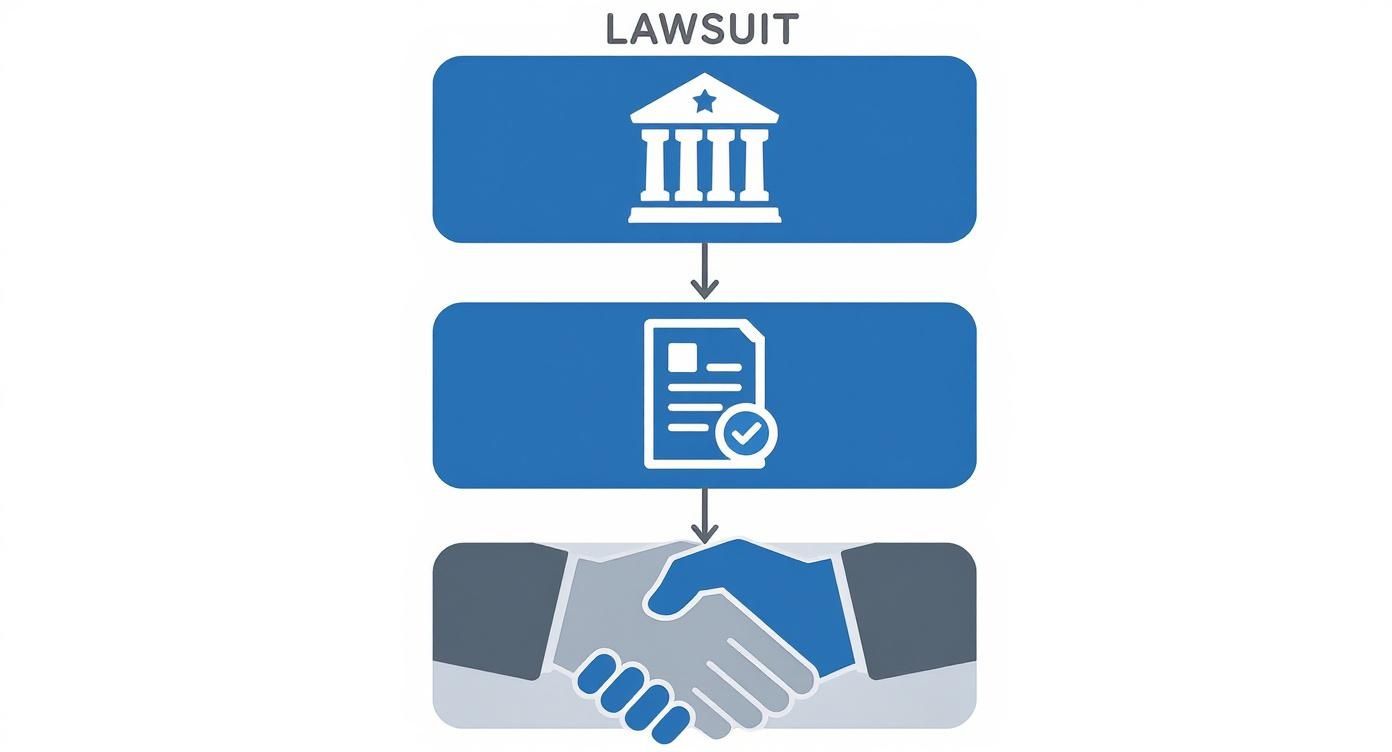
As you can see, getting the demand letter right is a pivotal moment in the life of a claim. It’s your opportunity to take control of the narrative and push for a fair resolution.
To do that, every demand letter needs to have a few key ingredients. We've broken down the essential components you need to include to make your case as strong as possible.
Table: Key Components of a Settlement Demand Letter
| Component | Purpose and Key Information |
|---|---|
| Factual Narrative | Sets the stage with a clear, objective account of what happened. Detail the date, time, location, and a step-by-step description of the incident. This is your "just the facts" section. |
| Liability Argument | Explains why the other party is legally responsible for your client's injuries. This is where you connect their actions (or inaction) to specific evidence like police reports, witness statements, and traffic laws. |
| Damages Breakdown | Provides a comprehensive, itemized list of all losses. This must include economic damages (medical bills, lost wages) and non-economic damages (pain, suffering, emotional distress). |
| The Demand Amount | The final section where you state the specific dollar amount you are demanding to settle the claim. This figure should be the logical sum of your calculated damages, with room for negotiation. |
Each of these components plays a crucial role in building a case that an insurance company has to take seriously. Let's dig a little deeper into each one.
1. Tell the Story: A Clear and Factual Narrative
Your letter needs to start by setting the scene with a completely objective account of the incident. This is not the time for dramatic flair or angry accusations. You need to present an undeniable sequence of events, almost like a journalist reporting a story.
Stick to the who, what, where, and when. State the date, time, and location, and then walk the reader through exactly how things unfolded. By laying out the facts cleanly, you establish credibility right out of the gate.
2. Prove It: Establishing Undeniable Liability
Once you've explained what happened, it’s time to prove why the other party is legally responsible. This is your liability section, and your job is to draw a straight line from their actions to your client's injuries. You’re building the legal framework that proves they are at fault.
Here, you need to bring in your evidence. Back up your argument with things like:
- Police Reports: These are gold, especially if they cite the other party for a violation.
- Witness Statements: Third-party accounts that confirm your version of events are incredibly powerful.
- Traffic Laws: Pinpoint the specific statute the other party broke. For example, citing a failure to yield or an illegal lane change.
When you methodically prove liability, you corner the insurance company. You make it difficult for them to argue that their insured wasn't the one at fault.
3. Show the Harm: A Complete Breakdown of Damages
This section is the heart and soul of your settlement demand letter. You have to provide a detailed, itemized list of every single loss your client has suffered. We typically break this down into two main categories.
First are the economic damages. These are the tangible, easy-to-calculate financial hits: medical bills, lost income, prescription costs, and property damage. They are the black-and-white numbers with receipts to back them up.
Second, you have to address the non-economic damages. These are the very real, but intangible, human costs of the injury—the pain, the suffering, the emotional trauma, the loss of enjoyment of life. To see a great example of how to structure this section, check out our auto accident demand letter sample.
4. Name Your Price: The Final Settlement Demand
Finally, you get to the point: stating the specific dollar amount you will accept to resolve the claim. This number shouldn't feel like it was pulled from thin air. It has to be the logical conclusion of the meticulously documented damages you just laid out.
Your opening demand should be firm and confident, but it should also be strategic. It's your starting point for negotiation. This figure represents the full value of your claim, backed by the evidence and arguments you’ve just presented, and sets a strong anchor for the discussions to come.
Building Your Case with Compelling Evidence
A settlement demand letter without solid evidence is just wishful thinking. It's an empty argument that an insurance adjuster has no reason to take seriously. To get them to write a check, you have to do more than just state your case—you have to prove it, piece by piece.
Think of it this way: you're not just telling a story; you're presenting an airtight case file. Your job is to assemble such a clear and overwhelming collection of proof that the adjuster has nowhere to go. There should be no room for doubt, no gaps to exploit. Every document, every photo, and every report needs to work together to validate your claim.

It’s not about dumping a pile of papers on someone's desk. It's about strategically organizing your evidence to create a powerful and undeniable narrative of what happened and how it affected you.
The Essential Evidence Checklist
Your demand package needs to be a comprehensive collection of documents that covers every angle of your claim. Each piece of evidence has a specific job to do, whether it's locking down liability or detailing your financial and personal suffering. This proof is the bedrock of your entire demand.
Here's the must-have evidence you need to start gathering:
- Official Accident or Police Reports: This is often the single most important document for proving who was at fault. An official report that assigns blame to the other party is a powerful, objective piece of evidence that's tough for an insurer to argue against.
- Medical Records and Bills: You need a complete paper trail for every single medical interaction, from the first ER visit to the final physical therapy session. This means gathering diagnostic reports like X-rays and MRIs, detailed notes from your doctors, and itemized bills that clearly show the cost of your treatment.
- Photos and Videos: Nothing tells a story like a picture. Visual evidence is incredibly compelling. Make sure you have clear photos of the accident scene itself, the damage to any vehicles involved, and any visible injuries you sustained. If you have dashcam footage or a bystander's video, even better—it's undeniable.
- Witness Statements: A testimony from an impartial third party who saw what happened can be a game-changer. It backs up your account of the events. Be sure to get their name, contact info, and a signed statement describing what they witnessed.
Documenting Your Financial and Personal Losses
Proving fault is only half the battle. You also have to meticulously document every single loss you've suffered—financial, physical, and emotional. This is where you draw a direct line from the incident to the real-world impact on your life. For a deeper dive, check out our guide on the different types of damages in personal injury cases.
Your evidence should paint a complete picture of your life before and after the incident. The more detailed and organized your documentation, the harder it is for an insurer to downplay your losses.
To make sure your damages are fully accounted for, include these key items:
- Proof of Lost Income: Don't just say you missed work. Prove it. Get pay stubs and an official letter from your employer that details your normal pay rate, the exact hours you missed, and the total wages lost because of your injuries.
- Property Damage Estimates: For any damaged property, like your car, get at least two professional repair or replacement estimates. This shows you've done your due diligence and helps validate the cost.
- A Pain and Suffering Journal: This is your personal record of the human cost. Keep a daily log of your pain levels, your emotional state, and all the specific ways your injuries have disrupted your life. Can't play with your kids? Can't enjoy your favorite hobby? Write it all down.
How to Calculate a Fair Settlement Demand
This is it—the moment you put a number on your claim. Crafting the dollar figure for your settlement demand letter is arguably its most critical component. This isn’t a guessing game. It’s a carefully considered calculation meant to cover every loss you've suffered while also paving the way for negotiation.
The goal is to aim high enough to give yourself some wiggle room, but not so high that the adjuster dismisses it out of hand. To strike that balance, you need to understand the two core types of damages that make up your claim. Think of them as two separate buckets you need to fill.
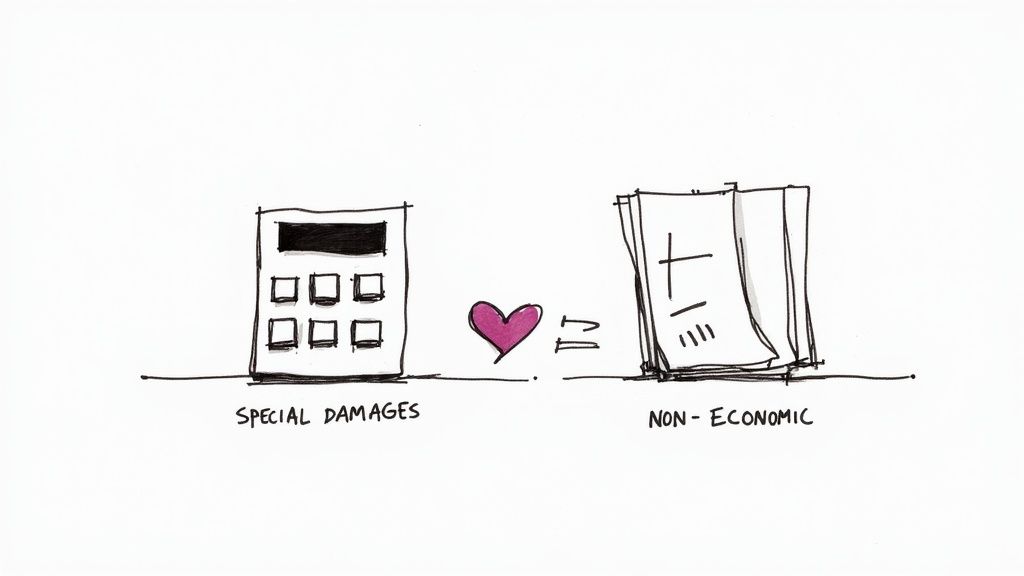
The first bucket is for your special damages, often called economic damages. These are the straightforward, tangible financial hits you took because of the incident—the losses with a clear paper trail.
Tallying Your Economic Losses
Special damages are the easy part, mathematically speaking. They represent concrete, provable costs. Your mission here is to become a detective, hunting down every single receipt, bill, and statement connected to the accident.
Your list of economic damages should cover things like:
- Medical Expenses: Every penny. This includes the ambulance ride, ER visit, surgeries, doctor follow-ups, physical therapy, prescriptions, and even medical devices like crutches or braces.
- Lost Wages: Add up all the income you lost because you couldn't work. Don't just count your base salary; include any missed overtime, commissions, bonuses, or other perks.
- Future Lost Earning Capacity: This is a big one. If your injuries have permanently affected your ability to do your job or earn what you used to, you need to calculate that long-term financial impact.
- Property Damage: This is usually the cost to repair or replace your car, but it can also include any other personal items that were damaged, like a phone, laptop, or eyeglasses.
Once you add all these up, you have a solid number. This total is the foundation of your entire settlement calculation.
Valuing Your Pain and Suffering
The second bucket is for general damages, also known as non-economic damages. This is where we account for the very real human cost of an injury—the pain, the emotional distress, the sleepless nights, and the loss of enjoyment in life.
These losses don't come with a neat price tag, which makes them much harder to quantify.
So, how do you put a number on suffering? The most common method attorneys use is the "multiplier method." You take your total economic damages and multiply that figure by a number, usually between 1.5 and 5, to arrive at a value for your pain and suffering.
The multiplier you choose depends entirely on the severity of your injuries:
- A multiplier of 1.5 to 3 is typically used for less severe injuries where you've made a full and relatively quick recovery.
- A multiplier of 3 to 5 (or even higher) is reserved for serious, painful injuries that cause long-term complications or permanent damage.
Let's walk through an example. Say your total medical bills and lost wages (special damages) come to $20,000. If your injuries were serious and required surgery, you might justify a multiplier of 3. That would put your pain and suffering (general damages) at $60,000.
Add the two together ($20,000 + $60,000), and your total estimated claim value is $80,000. Your final demand should probably be a bit higher than that to leave room for the back-and-forth of negotiation.
To get a more detailed look at how these calculations work in practice, check out this guide on using a personal injury lawsuit calculator. Grounding your demand in solid data and established methods is the key to being taken seriously.
Critical Mistakes That Can Weaken Your Claim
You can build a rock-solid case, but simple, unforced errors in your demand letter can sink it before it ever sets sail. These mistakes are more than just typos; they can shred your credibility, show the insurance adjuster you're not prepared, and lead straight to a lowball offer or an outright denial.
Think of it like a high-stakes business proposal. If your proposal is full of emotional rants, sloppy math, or claims you can't back up, no one's going to take you seriously. Steering clear of these common traps is just as crucial as putting the right evidence in.
Using an Emotional or Threatening Tone
One of the fastest ways to get an adjuster to tune you out is to let your anger take over the keyboard. Yes, the situation is personal and deeply stressful, but your demand letter must be a fortress of objective, professional, and fact-based arguments.
Do This, Not That:
- Don't: "Your reckless client ruined my life, and you'll pay dearly for this injustice!" Language like this is just noise. It's aggressive, unprofessional, and instantly puts the adjuster on the defensive.
- Do: "The evidence clearly shows that your insured's negligence was the direct cause of the accident and my client's resulting injuries." This gets the job done. It's firm, confident, and rooted in the facts.
Let the evidence do the heavy lifting. A well-reasoned argument is far more powerful than any threat or insult.
Exaggerating Claims or Damages
Never, ever stretch the truth. Insurance adjusters are professional skeptics; they review claims for a living and have a finely tuned radar for exaggerations and inconsistencies. If you inflate medical bills, overstate your injuries, or fudge your lost wage numbers, you're handing them a reason to tear your entire claim apart.
Once you lose your credibility, it’s gone for good. A single white lie can cast a shadow over every legitimate part of your case, giving the insurer the perfect excuse to question everything.
Stick strictly to the facts supported by your medical records, pay stubs, and other hard evidence. The power of a settlement demand letter is in its accuracy, not its drama.
Submitting an Incomplete or Disorganized Package
A sloppy, disorganized demand package screams one thing: "I'm not ready for a fight." When documents are missing, the math is fuzzy, or the story is hard to follow, you're making the adjuster's job harder. That almost always leads to delays or a quick lowball offer just to see if you'll go away.
Failing to provide solid proof is a critical error. This isn't just a personal injury problem, either. In 2020, for instance, U.S. businesses were on the hook for an estimated $6.625 billion in potential settlement costs from demand letters about web accessibility alone, where proving non-compliance was everything. You can learn more about the financial impact of demand letters on businesses.
Your goal is to make it easy for the adjuster to say "yes." Hand them a neat, organized package where every claim is backed by clear documentation. Guide them logically to the only possible conclusion: that your demand is reasonable and fully justified.
Your Top Questions About Demand Letters, Answered
Venturing into a personal injury claim can feel like navigating a maze. But when you understand the process, you gain a lot more control. The settlement demand letter is one of the most powerful tools in your arsenal, so it's normal to have a few questions. Let's clear up some of the most common ones.
What Happens After I Send the Demand Letter?
Once your letter is sent, the insurance company takes over. They'll assign an adjuster to your case who will dig into your claim, review all the evidence you provided, and scrutinize your demand amount. Don't expect a reply overnight—this review can take anywhere from a few weeks to a couple of months.
More often than not, their first move won't be to write you a check for the full amount. Instead, you'll likely receive a counteroffer. Don't be discouraged! This is actually a good thing; it means the negotiation has officially begun. In some cases, they might reject the claim entirely or simply ignore it. If that happens, it's a strong signal that you may need to file a lawsuit to get them to the table.
Can I Write a Demand Letter Without a Lawyer?
Absolutely. You are legally entitled to write and send a demand letter on your own. For smaller claims where the fault is obvious and the injuries are minor, handling it yourself can be a perfectly fine strategy. It keeps you in the driver's seat and saves you from paying legal fees.
However, if your case involves serious injuries, complicated facts, or the potential for long-term medical care, bringing in an attorney is almost always the right call. The moment an attorney gets involved, the insurance company knows you mean business. Lawyers also have the experience to properly calculate intangible damages like pain and suffering, making sure you don't accidentally ask for far less than your claim is worth.
An experienced attorney knows the insurance company’s playbook. They can spot and shut down lowball offers and other common tactics, which dramatically increases your chances of getting a fair settlement.
How Much Money Should I Ask For?
Figuring out what to ask for is more of a science than an art. The golden rule is to always start with a number that's higher than the minimum you’d be happy with. This gives you breathing room to negotiate down without ending up with a figure that doesn't truly cover your losses.
Here’s a simple, two-step way to get to a solid starting number:
- Add Up Your Economic Damages: First, tally up every single out-of-pocket expense. This includes all medical bills (past and future), lost income from time off work, and repair or replacement costs for any damaged property.
- Calculate Your Non-Economic Damages: Next, you need to put a price on your pain and suffering. A common way to do this is the "multiplier method." You take your total economic damages and multiply them by a number between 1.5 and 5, depending on how severe your injuries are and how much they've impacted your life.
Add those two numbers together, and you'll have a well-reasoned valuation for your claim.
Can My Demand Letter Be Used Against Me in Court?
For the most part, no. Rules of evidence, like Federal Rule of Evidence 408, are specifically designed to prevent settlement communications from being used in court to prove who was at fault or how much a claim is worth. The whole point is to let both sides negotiate freely without worrying that their offers will come back to haunt them at trial.
But there’s a catch. While the offer itself is protected, any factual statements you make in the letter are not. This is why it is absolutely vital that everything you write is 100% accurate and truthful. Stick to the facts and never, ever exaggerate your injuries or how the incident happened.
Knowing what similar cases are actually worth is the secret to a strong negotiation. Verdictly gives you a searchable database of real Texas motor vehicle verdicts and settlements, so you can anchor your demand in solid data. Arm yourself with real case insights and build a more powerful demand by visiting https://verdictly.co today.
Related Posts
A Guide to Medical Records Reviews in Personal Injury Claims
Learn how medical records reviews can strengthen your Texas injury claim. This guide explains the process, key findings, and how to build a stronger case.

Why Insurance Companies Deny Claims: why insurance companies deny claims
Learn why insurance companies deny claims and how to overcome common denials with proven appeals and tips to maximize your compensation.
How Much Can I Get From a Car Accident Settlement?
Wondering how much can I get from a car accident? This guide breaks down settlement factors, damages, and claim values to help you estimate your compensation.