
comparative negligence in texas: Shared Fault Explained
comparative negligence in texas: How shared fault affects your claim and compensation.
In Texas, if you're partially to blame for an accident, a legal rule called comparative negligence kicks in to figure out how much money, if any, you can recover. The concept is pretty straightforward: if a jury finds you 51% or more at fault, you walk away with nothing. But if your share of the blame is 50% or less, you can still get compensation, it's just reduced by your percentage of fault.
Decoding Texas's 51% Bar Rule
Think of it like splitting a dinner bill with a friend. If they ordered the lobster and you just had a side salad, it wouldn't make sense to split the check down the middle. Instead, you'd each pay for what you got. Texas's approach to comparative negligence applies a similar logic, making sure financial responsibility is assigned based on each person's actual role in an accident.
This system is officially called modified comparative negligence, and the most critical part to understand is the 51% Bar Rule. This rule creates a sharp, unforgiving cut-off for recovering any money at all.
Here’s how it works in practice:
- If you are 50% or less at fault: You can recover damages from the other party. Your final award, however, will be reduced by your exact percentage of fault.
- If you are 51% or more at fault: You are completely barred from recovering compensation. Your claim is worth zero.
This all-or-nothing threshold means that a single percentage point can make or break your case. Being found 50% responsible means you get half of your damages; being found 51% responsible means you get absolutely nothing.
A Brief History of Texas Negligence Law
This wasn't always the law of the land. Before 1973, Texas operated under a much harsher rule known as contributory negligence. Back then, if you were found even 1% at fault for an accident, you were completely barred from recovery.
The state legislature moved to the current system to create what was seen as a fairer approach. This rule is now codified in Chapter 33 of the Texas Civil Practice & Remedies Code, which clearly states that a claimant can only recover damages if their percentage of responsibility is not greater than 50%. For a deeper dive, check out this comprehensive guide on Texas law.
The 51% bar rule creates a high-stakes environment where proving the other party was mostly at fault isn't just a goal—it's a requirement for financial recovery.
To see just how unique the Texas system is, it helps to compare it with the rules other states follow. Each one handles shared fault differently, which can drastically change the outcome for someone seeking compensation.
How Different Negligence Rules Compare
The table below breaks down the three main systems used in the United States, showing just how different a case can turn out depending on which rule applies.
| Negligence Rule | How It Works | Example (Plaintiff is 60% at Fault) |
|---|---|---|
| Pure Contributory Negligence | If the plaintiff is even 1% at fault, they recover nothing. | Plaintiff recovers $0. |
| Pure Comparative Negligence | The plaintiff's recovery is reduced by their exact percentage of fault, with no cut-off. | Plaintiff recovers 40% of their damages. |
| Modified Comparative Negligence (Texas's 51% Rule) | The plaintiff can only recover if their fault is 50% or less. If so, their recovery is reduced by their fault percentage. | Plaintiff recovers $0 because their fault (60%) exceeds the 50% threshold. |
As you can see, Texas's rule is a middle ground between the harshness of contributory negligence and the leniency of pure comparative negligence. It's a system that demands a clear understanding of fault, as the financial stakes are incredibly high.
How Fault Percentages Impact Your Payout
It’s one thing to talk about comparative negligence in theory, but it’s another to see exactly how it hits your wallet. The percentage of fault assigned to you isn't just legal jargon—it’s a number that directly carves away at your final settlement or verdict.
Make no mistake: every single percentage point counts.
The math itself is straightforward. First, a jury or settlement negotiation determines the total value of your damages. Then, that total is reduced by your specific percentage of fault. Simple as that.
Proportionate Responsibility in Action: Think of it this way: you are financially responsible for your share of the blame. If you're found 10% at fault, you essentially "pay" for that 10% by having your total award reduced by the same amount.
This is why the battle over a few percentage points can become the most important part of a case. Let's break down how this works with a real-world example.
The Financial Impact of Shared Fault
Imagine you were injured in a car wreck, and your total damages—for medical bills, lost income, and pain and suffering—come out to $100,000. That’s our starting point.
Now, watch how assigning just a little bit of fault changes what you actually take home.
- You are found 10% at fault: Your $100,000 award is cut by 10% ($10,000). Your final payout is $90,000.
- You are found 25% at fault: Your award is reduced by 25% ($25,000). You walk away with $75,000.
- You are found 49% at fault: Your award is slashed by 49% ($49,000), leaving you with $51,000.
As you can see, even a small slice of responsibility can cost you dearly. The system is designed to let you recover money even if you’re partially to blame, but it stops you from being paid for the part of the harm you helped cause. This gradual reduction, however, comes to an abrupt halt at a very specific point.
The 51% Rule: A Financial Cliff
The most critical part of comparative negligence in Texas is the 51% Bar Rule. This rule isn't a gradual slope; it's a sheer cliff. The moment your assigned fault hits 51%, your ability to recover damages doesn't just shrink—it evaporates.
Let’s go back to our $100,000 case to see how unforgiving this cutoff is.
-
Scenario A: You are 50% at fault.
- Your award is reduced by your 50% share.
- Calculation: $100,000 - ($50,000) = $50,000.
- You receive $50,000.
-
Scenario B: You are 51% at fault.
- Because your fault now equals or exceeds the other party's, the 51% bar kicks in.
- You receive $0.
That one percentage point is the difference between a significant financial recovery and walking away with absolutely nothing. Insurance adjusters know this rule inside and out and will fight hard to push your fault percentage over that 50% line to deny the claim entirely. To better prepare for these tactics, you can find helpful strategies in this complete guide to car accident settlements.
The chart below gives you a clear visual of how your fault and payout are balanced in Texas, as long as you stay under that crucial 51% threshold.
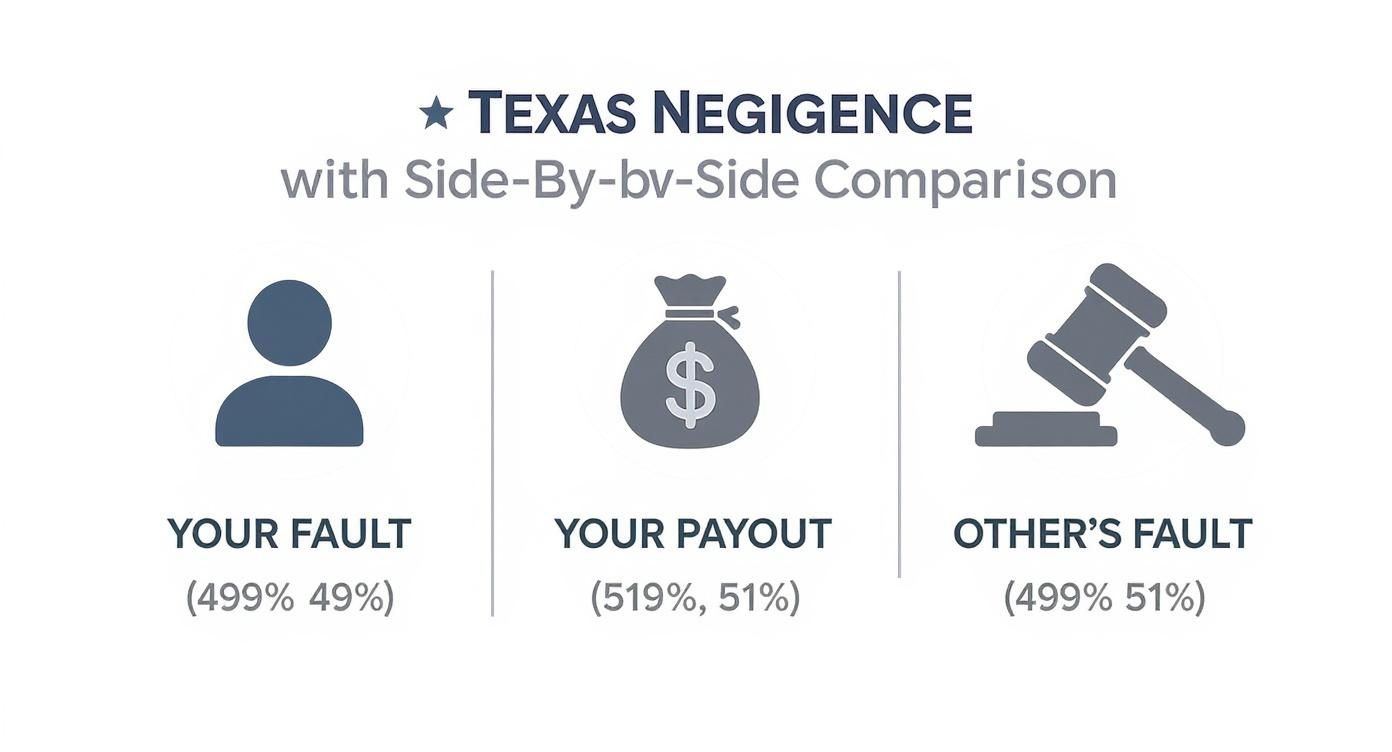
This visual really drives the point home. There's a direct trade-off: every percentage point of fault that lands on your shoulders is a percentage point taken directly from your payout, right up until the scales tip and your responsibility is no longer less than the other party's.
How Fault Is Determined in Real Texas Cases
When you're dealing with a Texas accident claim, the percentage of fault assigned to each person isn't just a number pulled from thin air. Insurance adjusters and, if it goes to trial, juries are tasked with a serious job: piecing together exactly what happened based on hard evidence.
Their goal is to reconstruct the moments leading up to the incident to figure out who failed to act with reasonable care. It's less of a guessing game and more like a detailed investigation where every piece of information helps build the complete picture.

The Evidence That Shapes the Outcome
To figure out who was at fault, investigators lean heavily on a few key types of evidence. The quality and clarity of this proof are what ultimately sway the final percentages.
Here are the main sources they turn to:
- Official Police Reports: This is almost always the starting point. The report includes the officer’s on-scene observations, notes from witness interviews, and often a preliminary opinion on who broke a traffic law.
- Witness Interviews: A statement from an unbiased third party can be incredibly persuasive. A credible witness who saw the other driver blow through a red light can completely change the dynamic of a case.
- Photographic and Video Evidence: In our hyper-connected world, this is gold. Dashcam footage, surveillance video from a nearby storefront, or even the photos you snap on your phone right after the crash can offer undeniable proof.
- Expert Analysis: In more complicated cases, you'll see accident reconstruction experts get involved. These specialists use physics and engineering to recreate the collision, providing a scientific opinion on things like speed, impact angles, and what caused the crash.
Think of each piece of evidence as a puzzle piece. The more pieces you have, the clearer the final picture becomes, making the fault assignment more accurate and defensible. When the picture is blurry or contradictory, that’s when disputes heat up.
Frameworks for Assigning Blame
While evidence lays the factual groundwork, adjusters and juries often use practical frameworks to guide their thinking. One common benchmark you’ll hear about in the Texas legal world is what some call the “75/25 rule of thumb.”
This isn't a law, but a guideline suggesting that the person who created the dangerous situation—the one who set the accident in motion—should shoulder the vast majority of the blame, typically 75% or more. The logic is straightforward: if they hadn't been negligent, the incident likely never would have happened.
As a result, the injured person’s own fault is often weighed on a scale from 0% to 25%. A higher percentage might be assigned if they were significantly distracted or contributed to the chain of events in a meaningful way. You can read more about how this shared fault principle works in real-world scenarios.
This framework just provides a starting point for negotiations. An insurance company might argue your momentary distraction puts you at 30% fault, while your attorney will use the evidence to show it was closer to 10%.
A Real-World Carrollton Case Study
Seeing how these rules play out in an actual courtroom is incredibly telling. A recent Carrollton jury, for instance, had to untangle a car crash where it was clear both drivers shared some blame. After hearing all the evidence, they did their job and assigned responsibility.
The jury found the plaintiff was 40% negligent and the defendant was 60% negligent. Because the plaintiff's fault was under the 51% bar, they could still recover money. However, their total award of $36,604 was cut by their 40% share of the fault.
You can explore the details of this shared negligence verdict to see a real jury in action. This case is a perfect example of how comparative negligence in Texas isn't just a theory—it confirms that having some fault doesn't kill your case, as long as it stays below that critical 51% threshold.
Proven Strategies to Reduce Your Assigned Fault
Knowing the rules of comparative negligence is one thing, but actually protecting yourself from being unfairly blamed is a whole different ball game. What you do—and don't do—in the moments, days, and weeks after an accident can massively swing your assigned percentage of fault and, in turn, how much money you can recover.
Think of it this way: the aftermath of a crash is when you start building your case. Every conversation, every photo, every decision can either solidify your claim or give the other side's insurance company the ammunition they need to point the finger at you. This isn't about being dishonest; it's about being smart and preserving the facts.

Your Immediate Post-Accident Playbook
The evidence that will make or break your case starts piling up the second the collision happens. A clear, proactive approach at the scene is your best defense against having the blame unfairly shifted to you.
Here's what you need to do right away:
- Never Admit Fault: It’s human nature to want to be polite, but phrases like "I'm so sorry" or "I didn't even see you" can be twisted into admissions of guilt. Stick to the facts when you talk to the other driver and the police.
- Document Everything Visually: Your phone is your best friend here. Snap dozens of pictures and videos from every conceivable angle. Get shots of the vehicle damage, skid marks on the road, traffic signs, weather conditions—anything and everything. A picture is often far more powerful than a verbal description.
- Gather Witness Information: Independent witnesses are gold. If anyone saw what happened, get their name and phone number. A neutral third-party account can completely shut down the other driver’s self-serving version of events.
- Call the Police: Always insist on an official police report. It’s a foundational piece of evidence, providing a trained officer's initial assessment of the scene.
Protect Your Claim After Leaving the Scene
The job isn't done when you drive away. How you manage your medical care and communications in the following days is just as critical for keeping your assigned fault at zero.
First, seek medical attention immediately, even if you feel okay. Adrenaline is a powerful pain-masker, and waiting to see a doctor gives an insurance company an easy excuse to argue your injuries aren't from the crash. Getting checked out creates a clear, documented link between the accident and your physical harm.
You also need to be incredibly careful when speaking with the other driver’s insurance adjuster. They are masters at asking leading questions designed to get you to say something—anything—that implies you were partly to blame. Give them only the basic facts and never agree to a recorded statement until you've spoken with a lawyer.
Your goal is to build a wall of evidence that backs up your side of the story. The stronger that wall is, the harder it is for an adjuster to poke holes in it and assign you an unfair percentage of fault.
The Role of a Skilled Attorney
While you can and should lay this groundwork, fighting back against an unfair fault percentage often requires calling in a professional. An experienced personal injury attorney is your best advocate for getting fair treatment under Texas's comparative negligence system.
They can take charge of several critical tasks you simply can't handle on your own:
- Conducting a Formal Investigation: Lawyers can subpoena surveillance footage from nearby businesses, bring in accident reconstruction experts, and uncover evidence you would never be able to access.
- Managing Communications: They take over all calls and correspondence with the insurance companies. This shields you from their manipulative tactics and ensures nothing you say can be used against you.
- Building a Compelling Narrative: A great attorney knows how to weave all the evidence—the police report, photos, witness testimony, and medical records—into a powerful and persuasive story that leaves no doubt about the other party's primary responsibility.
By methodically assembling and presenting this proof, your attorney can dismantle the other side's arguments and fight to keep your fault percentage as low as possible, protecting the full value of your claim.
Putting It All Together: Your Path Forward
Getting a handle on comparative negligence in Texas is your first and most important step toward securing fair compensation. This isn't just about dusty law books; it’s a practical framework that decides how much money you can actually recover after an accident.
Let’s boil it down to the two most critical points. First, remember that Texas follows a modified comparative negligence rule. This is good news because it means you can still get paid even if you were partially at fault.
But here’s the second, and arguably more important, point: everything comes down to the strict 51% Bar Rule. If a jury or insurance adjuster decides you were 50% or less to blame, you can collect damages. The second your fault tips over to 51%, your right to compensation is completely wiped out. It's a harsh cutoff.
Taking Control of Your Claim
The math is simple: whatever percentage of fault is assigned to you gets subtracted from your final award. This reality makes every single piece of evidence and every step you take after the incident absolutely vital. A little preparation goes a long way in protecting the value of your claim.
- Become a Documentarian: Pull out your phone and take pictures and videos of everything—the vehicles, the road conditions, the traffic signals. This kind of raw, on-the-scene proof is incredibly powerful.
- Stay Quiet on Fault: Be careful what you say. A simple "I'm sorry" can be twisted into an admission of guilt by an insurance adjuster. Stick to the facts.
- Get Medical Attention Immediately: Don't tough it out. Seeing a doctor right away creates an official record that ties your injuries directly back to the accident, leaving no room for doubt.
At the end of the day, successfully handling a personal injury claim is about knowing the rules of the game. When you understand the law, gather the proof, and get the right advice, you’re no longer on the defensive.
This knowledge changes your role from being a victim of circumstances to being an advocate for your own recovery. Even in cases that seem simple, like the ones we detail in our guide to single car accident claims, fault can be a surprisingly complex issue. By being proactive, you put yourself in the best possible position to fight for the compensation you deserve.
Common Questions About Texas Negligence Laws
Once you get the hang of the basics, you start to see how Texas's comparative negligence rules can get a little tricky in the real world. Let's walk through a few common questions that pop up all the time.
Think of this as moving from the textbook theory to how things actually play out after an accident.
What Happens If Multiple People Are At Fault?
It’s rare for an accident, especially a multi-car pile-up, to be a simple two-party affair. When several people share the blame, a Texas jury is tasked with assigning a specific percentage of fault to everyone involved—you, the other drivers, and anyone else whose actions contributed to the incident.
This is what lawyers call proportionate responsibility. The good news is, as long as your own slice of the fault pie is 50% or less, you can still recover damages. Your total award is just reduced by your fault percentage, and you can then collect from the other at-fault parties according to their individual shares of the blame. It’s a system designed to hold each person financially accountable for the part they played.
Does This Law Apply to All Personal Injury Cases?
Pretty much, yes. This modified comparative negligence system is the standard for almost every personal injury case in Texas rooted in someone's carelessness.
You’ll see it come up in all sorts of situations:
- Car and truck wrecks, from minor fender-benders to catastrophic highway collisions.
- Slip and fall incidents, where a property owner didn't keep their premises safe.
- Other premises liability claims, like injuries from poor security or even dog bites.
- Medical malpractice claims, where a doctor or hospital's negligence caused harm.
The bottom line is always the same: what you can recover is directly tied to your percentage of fault. The main exception is for cases involving intentional harm, like an assault, which are handled under a completely different set of legal rules.
How Do I Prove the Other Party Was More Than 50 Percent At Fault?
This is the million-dollar question, and the answer is always evidence. You can’t just walk into a negotiation or a courtroom and say the other driver was more to blame. You have to prove it.
Building a strong case means weaving together different types of proof into a clear story. Think police reports, witness statements, photos of the scene, and sometimes, expert analysis from accident reconstructionists. It's about creating a narrative, backed by facts, that leaves little doubt about the other party's negligence. An experienced attorney is crucial here; they know how to dig for the evidence needed to push that fault percentage past the critical 50% mark.
At Verdictly, we know that solid data leads to smarter decisions. Our platform gives you access to real verdict and settlement numbers from cases across Texas, letting you benchmark your case and see what similar claims are actually worth. Explore our database to see what's possible before you head to the negotiating table.
Related Posts
Pain and Suffering Calculation (pain and suffering calculation): Texas Damages
Explore how the pain and suffering calculation works in Texas, including multiplier and per diem methods, to help you estimate your settlement.